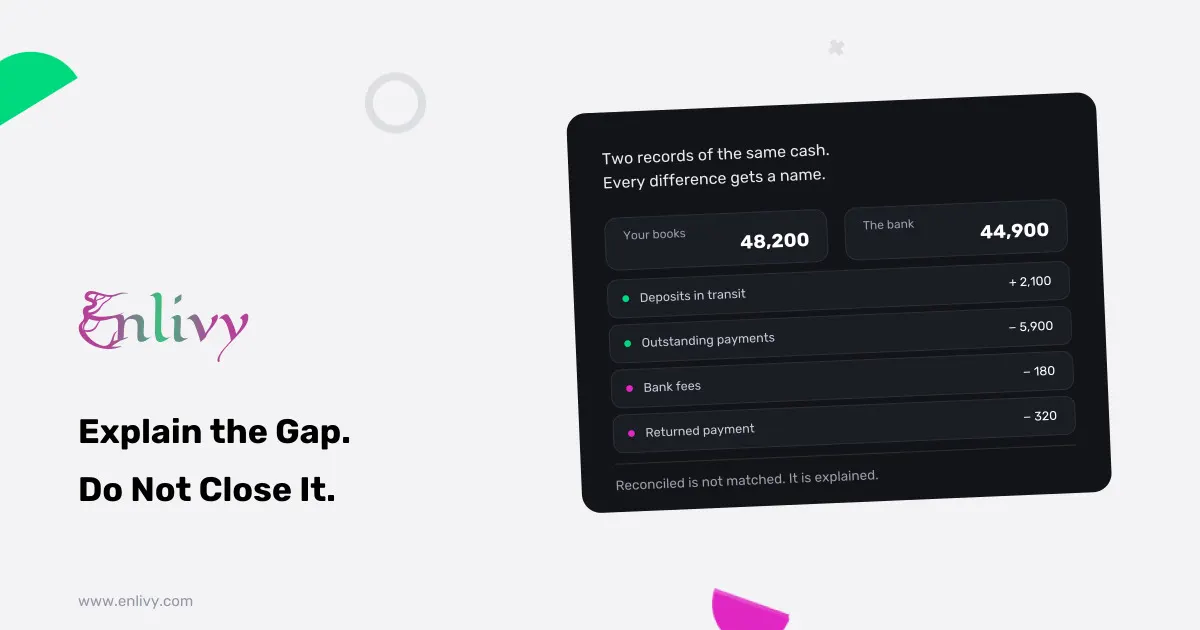
Your books say you have 48,200. The bank says 44,900. Neither number is wrong, and until you can explain the 3,300 between them, you do not actually know how much money you have.
Bank reconciliation is the work of explaining that gap. Not closing it, explaining it: every difference should have a name, a date and a reason.
What it actually is
A bank reconciliation compares two records of the same cash over the same period, and accounts for every item that appears in one but not the other.
Your ledger records money when you act. You issue an invoice, record a payment, send a transfer. The bank records money when it moves. Between those two moments sit days, fees you did not know about, and payments that left one account before arriving in another.
The output is not a matching number. It is a short list of named differences, and a statement that nothing else remains unexplained.
Why the two numbers differ
Almost every difference falls into one of six categories. Knowing them turns reconciliation from hunting into checking.
| Item | What it is | Which side is behind |
|---|---|---|
| Deposits in transit | Money you received and recorded, not yet cleared | Bank |
| Outstanding payments | Payments you issued that have not been presented | Bank |
| Bank fees | Account, transfer and currency charges you did not book | Your books |
| Interest earned | Credited by the bank, not yet recorded | Your books |
| Returned payments | A payment that bounced after you recorded it | Your books |
| Errors | A transposed figure or a duplicate, on either side | Either |
The first two are timing. They resolve themselves and appear on next month’s statement. The middle three are information the bank had and you did not, which is why they are found rather than predicted. The last one is the reason the process exists at all.
The process, step by step
-
Fix the period and the starting point. Last period’s reconciled closing balance is this period’s opening balance. If it was never reconciled, start there instead. Reconciling on top of an unreconciled period produces a number that means nothing.
-
Tick off what matches. Same amount, same date, same direction. In most months this is 80 to 95 percent of the lines and it should be mechanical.
-
Classify what does not. Work the six categories above rather than staring at the whole list. Anything you cannot place goes on a queries list with its date and amount, not into a suspense account.
-
Record what the bank knew and you did not. Fees, interest, returned payments. These are real transactions rather than adjustments, and they need a document behind them the same as any other cost.
-
Prove the arithmetic. Bank closing balance, plus deposits in transit, minus outstanding payments, equals your adjusted book balance. If it does not, the difference is still on the list somewhere.
-
Sign it off with a date. An unsigned reconciliation is a draft, and a draft is indistinguishable from one nobody finished.
How often is often enough
Monthly is the convention. It is also the reason most businesses do not know their cash position for three weeks out of four.
Monthly satisfies an accountant and nothing else. It is the minimum rather than a target.
Weekly is the point where the answer to “has this client paid” stops being somebody’s impression. For a business chasing invoices this is the meaningful threshold, because chasing an invoice that was settled four days ago costs more goodwill than the payment was worth.
Continuous is what a bank feed makes possible. Transactions arrive as they clear and matching becomes a state rather than an event. Reconciliation then stops being a task and becomes the absence of a queue.
The right frequency is not a matter of diligence. It follows from whether the data arrives without anyone fetching it, which is why the fix is usually connecting the account rather than trying harder each month. In Enlivy that takes the Banking pack, and a connected account syncs every few hours.
What breaks it at scale
Five situations account for nearly every reconciliation that takes a whole afternoon.
Partial payments. A client pays 60 percent now and the rest on delivery. The invoice is neither open nor closed, and a system that only understands paid and unpaid cannot hold the position.
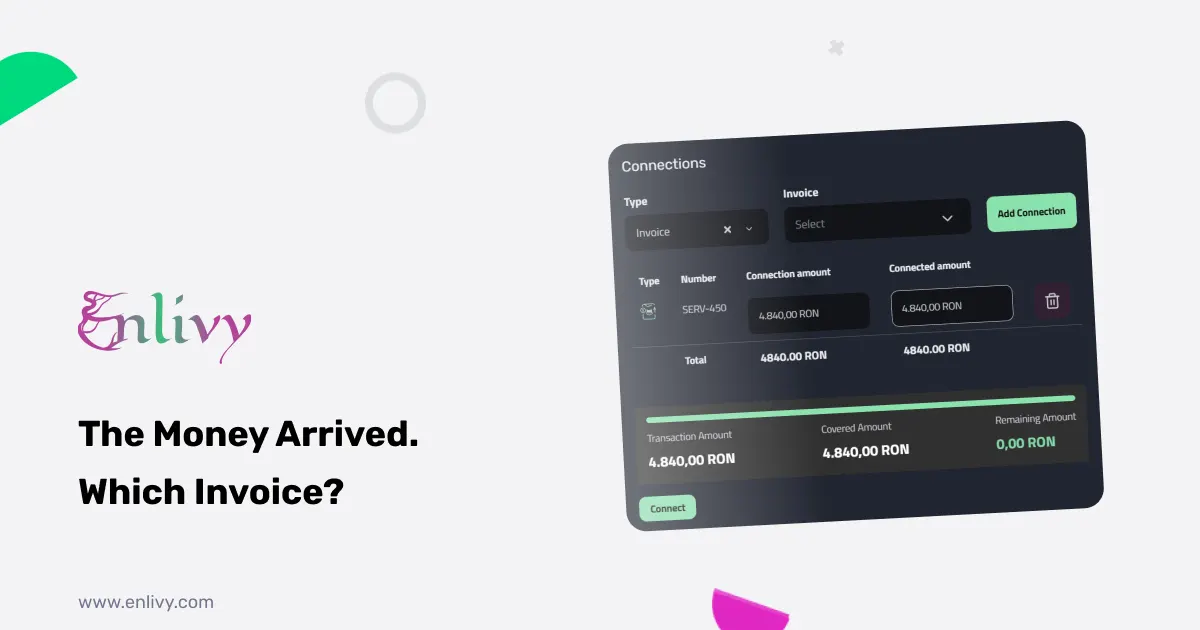
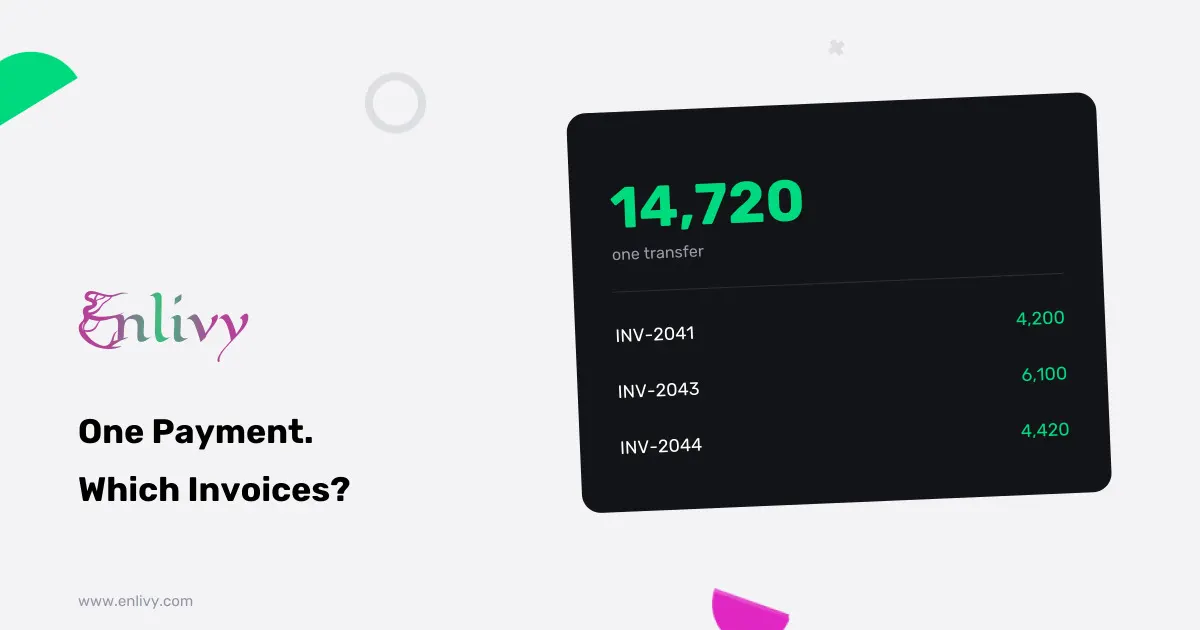
Bundled transfers. One round number settles three invoices, often with a deduction nobody mentioned. You are solving a small arithmetic puzzle to work out which three, and whether the shortfall was a credit note or an error.
Useless references. The payment reference says “invoice” or the client’s internal code. Matching falls back to amount and date, which works until two clients owe you the same figure.
Currency. The invoice was in euro, the money arrived in your local currency, and the amount that landed is neither the invoiced figure nor a round number, because of the rate and the bank’s cut. Both numbers are correct and they do not agree.
The month-end straddle. Money left on the 28th and arrived on the 2nd. The period boundary falls between, so the invoice looks unpaid in one month and paid in the next.
None of these are exotic. A service business meets all five in a normal quarter, which is covered in more depth in matching payments to invoices. Where a payer sends a note explaining what a transfer covers, that document is a remittance advice, and it removes most of this work before it starts.
Bank reconciliation is one kind of reconciliation
Worth separating, because the terms get used interchangeably.
Bank reconciliation compares your cash ledger to one bank statement. One account, one period, one external source that arrives whether you ask for it or not.
Account reconciliation is the wider discipline: proving that any ledger balance is supported by evidence. Receivables against invoices, payables against bills, tax accounts against filings.
Bank reconciliation is the one most businesses actually do, because the external record is handed to them. The others require assembling the evidence yourself, which is why they get skipped and why they are where errors survive longest.
What good looks like
A short test. Take a payment that arrived last week and answer three questions:
- Which invoice or invoices did it settle?
- Is anything still open on them?
- Is the amount that arrived the amount invoiced, and if not, why?
If all three take under a minute without opening your banking app, reconciliation is working. If any requires exporting a statement, it is not, and the gap widens as volume grows.
Two structural properties make that possible. Transactions have to arrive without you fetching them, and a payment has to be able to point at a document rather than a category. When each transaction is linked to the invoice, receipt or payslip it belongs to, a partial payment stops being ambiguous, because each linked payment shows how much of the invoice it covered.
What it feeds
Reconciliation is not an end in itself. It is the thing that makes three other numbers true.
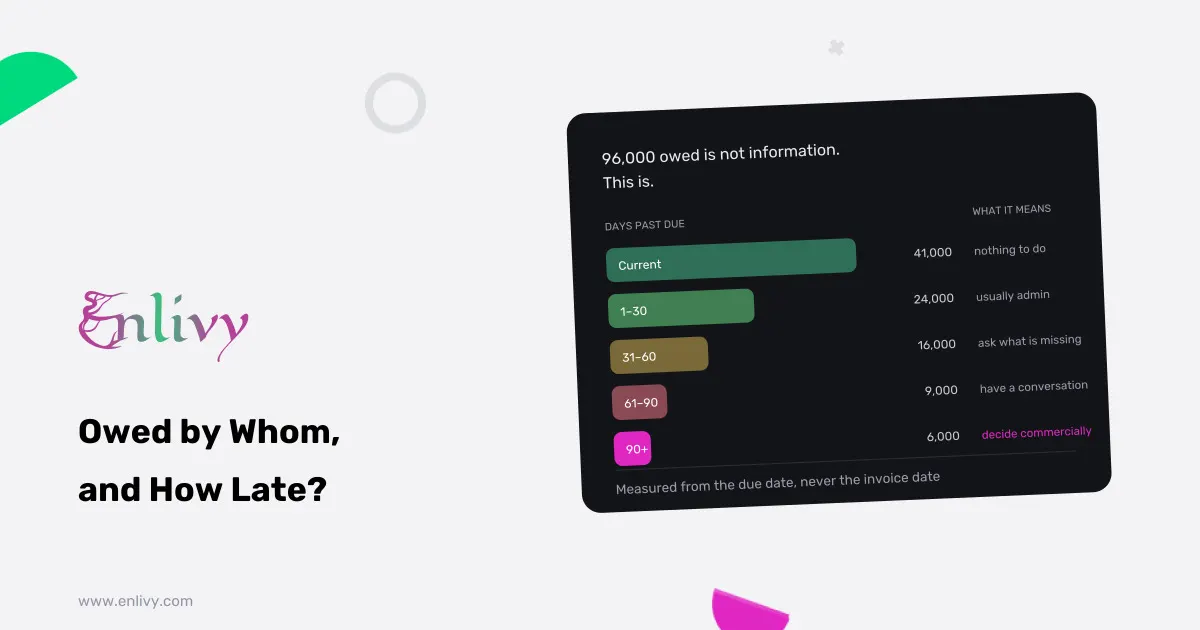
What you are actually owed. An aged receivables report built on unreconciled data lists invoices that were paid weeks ago.
How long you wait to get paid. Days sales outstanding is calculated from the receivables balance, so an unreconciled balance produces a metric that flatters or alarms at random.
Whether your terms are working. Comparing actual collection against the payment terms you set only means something once the payments are matched.
Downstream, the same linked records are what make the export your accountant needs a read rather than a reconstruction.
Where this sits in the wider chain
Reconciliation is the last handoff in the path from a signed agreement to money in the bank. That whole path, and the four points where it leaks, is the contract-to-cash workflow.
Much of what makes it painful was decided earlier. An invoice that did not match what the client accepted is one a client can pay partially. Terms never agreed in writing produce deductions you cannot argue with. And recurring revenue produces twelve payments a year per client, which is where manual matching stops scaling first.
Enlivy runs the banking side as a separate pack, so you can close this handoff without changing how you invoice. You can start free with CSV statements, up to 50 transactions a month, and add the Banking pack when you want the account connected.
If you are comparing this against a bookkeeping-first tool, the write-ups on QuickBooks, Xero and Wave each say where they win and where they stop.