Net 30 payment terms mean the full amount is due 30 days after the invoice date. That is the entire definition, and almost every dispute about it comes from the two words people skip: calendar days, from the invoice date.
The term is worth more attention than it usually gets. It is the clause that decides whether you are running a service business or lending your clients working capital for a month at zero percent.
What the words actually mean
“Net” means the full amount, with no discount applied. It does not mean net of tax.
“30” means 30 calendar days, not business days, unless the contract says otherwise. Nobody adds weekends back.
The clock starts on the invoice date by default. Not on delivery, not on receipt, not on approval, unless you agreed otherwise in writing.
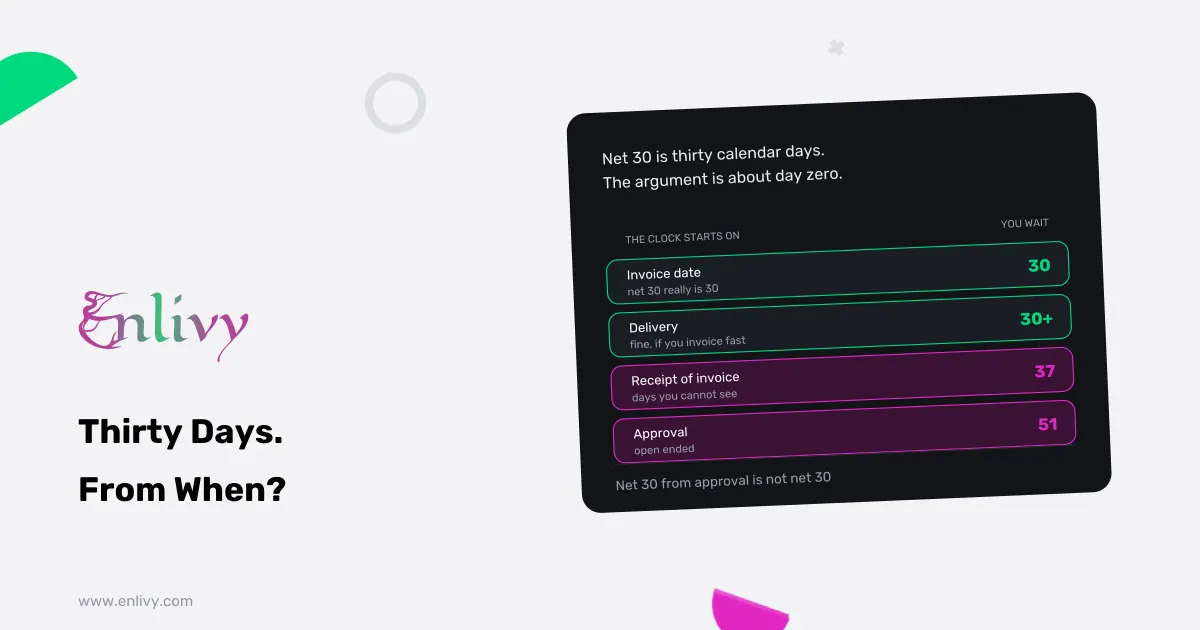
That default is where most of the argument lives, because there are four defensible answers and only one of them is automatic:
| Clock starts on | Effect on you | Typical of |
|---|---|---|
| Invoice date | Best. Standard default. | Most B2B services |
| Delivery or completion | Neutral, if you invoice promptly | Project work |
| Receipt of invoice | Adds days you cannot see | Larger buyers |
| Approval or acceptance | Worst. Open-ended. | Enterprise procurement |
“Net 30 from approval” is not net 30. If nobody approves for three weeks, it is net 51, and the delay is invisible because the invoice is not technically late.
Fix this by naming the trigger explicitly in the agreement rather than on the invoice, so the term survives whoever types the document.
The common terms, and what they signal
| Term | Meaning | When it fits |
|---|---|---|
| Due on receipt | Immediately | New clients, small amounts |
| Net 7 / Net 15 | 7 or 15 days | Freelancers, first engagements |
| Net 30 | 30 days | The B2B default |
| Net 45 / Net 60 | 45 or 60 days | Large clients, negotiated |
| 2/10 net 30 | 2% off if paid in 10 days | When cash matters more than margin |
| 50% upfront, net 30 | Split | Project work, new relationships |
Net 30 is the default because everyone recognises it, so proposing it costs no explanation. That is its real advantage: anything else has to be justified, and justification takes a conversation you may not win.
What 2/10 net 30 actually costs you
The early-payment discount looks generous and cheap. It is generous. It is not cheap.
2/10 net 30 means the client can take 2 percent off if they pay within 10 days, otherwise the full amount is due at 30. You are buying 20 days of cash by giving up 2 percent of revenue.
Annualise that and the picture changes:
(2 ÷ 98) × (365 ÷ 20) = roughly 37 percent a year
You are paying an effective annual rate around 37 percent for the money. Almost any other source of working capital is cheaper.
That does not make it wrong. It makes it a financing decision rather than a customer-service gesture. Offer it when cash timing genuinely constrains you and the alternative is worse. Do not offer it as a default courtesy, and do not offer it to clients who already pay on time, because they will take the discount and change nothing.
How to choose a term
Not a preference. Work down from your own cash cycle.
Start with when money leaves. If salaries go out on the 10th and suppliers at 30 days, collecting at 60 means you fund two months of operations from reserves. The term is a treasury decision before it is a sales one.
Shorter for new clients. Net 15 until the relationship settles. It is easier to relax a term later than to tighten one, and asking to tighten reads as distrust.
Net 30 as the standard, because it needs no defending.
Beyond 45 days, ask for something back. A deposit, guaranteed volume, or a higher price. Long terms given for free are an interest-free loan you did not agree to make.
Split long projects rather than extending terms. Deposit at signature, tranches at milestones, balance at completion. With the Billing Schedules pack, a billing arrangement holds all of it as one relationship with a running balance, rather than three unconnected invoices.
The clauses that make the term enforceable
The number of days is the easy part. These are what make it hold.
When the clock starts. Covered above, and the single highest-value sentence in the section.
Who receives the invoice. Name and email of the person in finance, not just your day-to-day contact. The most common cause of a late invoice is that it never reached anyone who could pay it.
Whether a purchase order is required. Many larger companies cannot pay without one. Discovering this at the due date costs a month.
What happens when it passes. Late interest, suspension of work, or both. Suspension is a real lever and only exists if it is written down. Without it, stopping work puts you in breach.
How disputes pause the clock. Otherwise a query on one line freezes the whole invoice indefinitely.
Measuring whether it works
A term you never check is a preference. Two numbers tell you whether clients are honouring it.
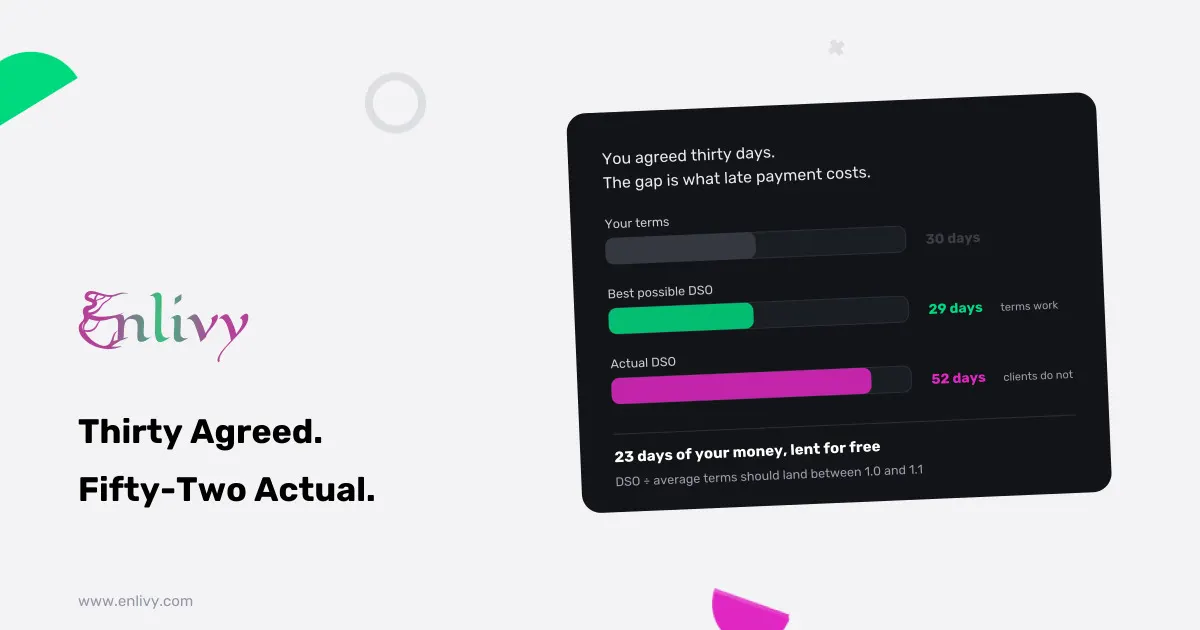
Days sales outstanding against your average terms. Sell on net 30 and collect in 33, and the ratio is 1.1, which is healthy. Collect in 52 and the terms are decorative.
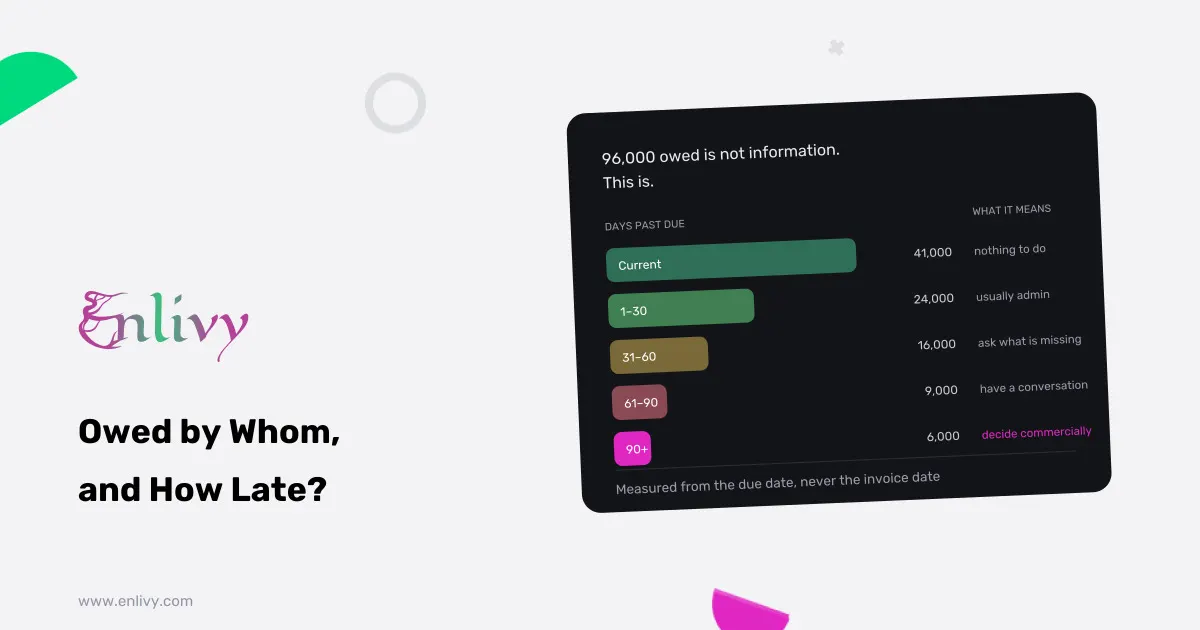
The aged receivables report, because the average hides the distribution. Half your clients at 30 and a few at 90 produce the same average as everyone at 45, and they call for completely different responses.
Both numbers depend on payments being matched to invoices promptly, which is the argument in bank reconciliation. Computed on a stale balance, they measure your bookkeeping instead of your clients.
Where this sits in the wider chain
Payment terms are set early and paid for late. The decision belongs in the agreement, the consequence shows up in your bank account, and the whole path between the two is the contract-to-cash workflow.
Downstream, when a date passes anyway, the sequence that recovers the money without damaging the relationship is in what to do when an invoice is not paid. Upstream, the term should already appear in the statement of work the client accepted, and be inherited by the invoice rather than retyped, which is the subject of from accepted proposal to paid invoice.
Enlivy keeps the agreement, the schedule and the invoice linked and sells the parts as separate packs, with the schedule on the Billing Schedules pack. You can start free with the agreement and the invoices.
If you are comparing tools, the write-ups on FreshBooks, QuickBooks and Bonsai say where each of them wins.
Sources: net 30 conventions, 2/10 net 30 explained.