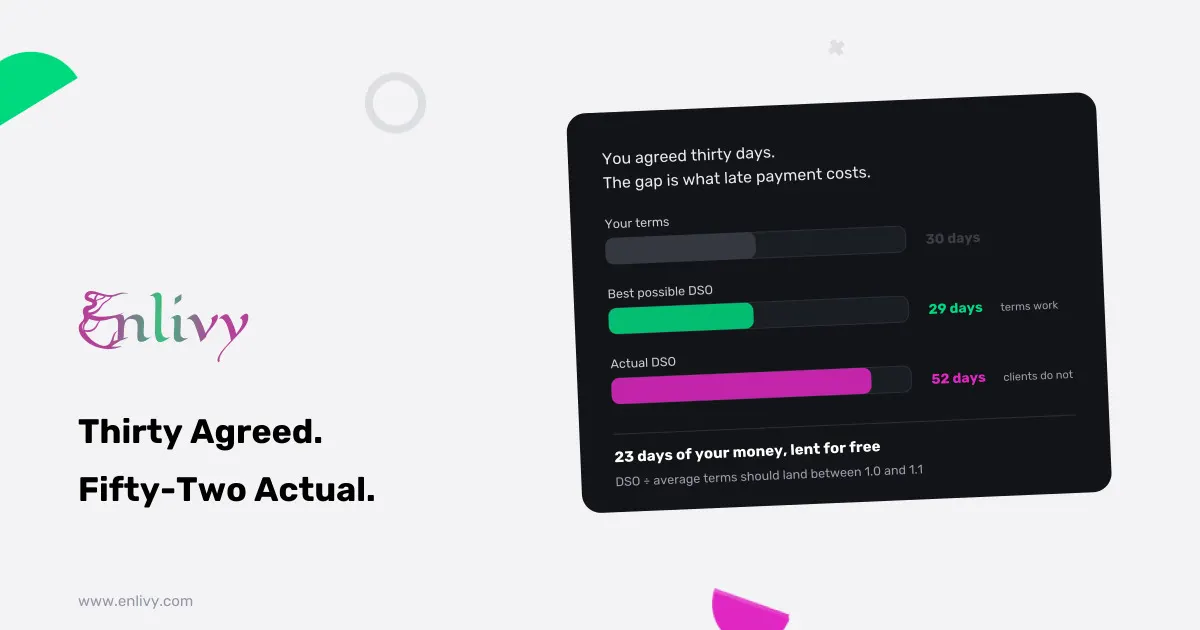
You agreed 30-day terms. You are getting paid in 52. The gap between those two numbers is the amount of your own money you are lending your clients, and days sales outstanding is how you measure it.
It is the one receivables number worth tracking monthly. It is also easy to calculate in a way that flatters you.
The standard formula
DSO = (Accounts Receivable ÷ Total Credit Sales) × Days in Period
Written plainly: take what you are owed at the end of the period, divide by what you invoiced during it, multiply by the number of days.
An example. You end March owed 84,000. You invoiced 61,000 during March, which has 31 days.
84,000 / 61,000 × 31 = 42.7 days
Three details decide whether that number is honest:
Credit sales only. Anything paid immediately never becomes a receivable and does not belong in the denominator. Include it and your DSO drops without anything improving.
Excluding tax, consistently. VAT sits in both the receivable and the sale, so either include it in both or neither. Mixing them shifts the answer by several days.
On a reconciled balance. If the receivables figure contains invoices that were paid but never matched, the metric measures your bookkeeping rather than your clients. That is the whole argument in account reconciliation.
Why the simple formula misleads a growing business
Here is the trap, and it catches exactly the businesses that most need the number.
The standard formula divides a balance that reflects several months of invoicing by revenue from one month. When monthly revenue is flat, this is fine. When it is growing, the receivable is large relative to the most recent month and the calculation is unfair to you. When revenue just dropped, DSO looks better precisely when collections are getting worse.
A business growing 20 percent month over month, or one with seasonal peaks, gets a number that moves for reasons unrelated to how fast clients pay.
The countback method fixes it. Start with the closing receivables balance and walk backwards through your invoicing, month by month, subtracting each month’s sales until the balance is used up. The number of days you counted back is the DSO.
Same 84,000 owed, and suppose March invoicing was 61,000 and February 47,000. March absorbs 61,000 of the balance, leaving 23,000. That is roughly half of February’s 47,000, so about 14 of February’s 28 days. Counting back: 31 + 14 = 45 days.
The simple formula said 42.7. The countback says 45. On a stable business they converge; on a moving one they do not, and the countback is the one describing reality. Reach for it when revenue is seasonal or growing quickly, and use the simple version otherwise because it is easier to explain.
Best possible DSO, and why the gap is the real number
There is a second calculation worth running, and it is more useful than the headline.
Best possible DSO uses only your current, not yet overdue receivables in the numerator. It tells you what your DSO would be if nobody paid late.
The result should land close to your stated terms. If you sell on net 30 and your best possible DSO is 29, your terms and your invoicing are consistent.
Then compare:
| What it tells you | |
|---|---|
| Best possible DSO | What your terms would produce |
| Actual DSO | What your clients produce |
| The gap | What late payment is costing you, in days |
The gap is the actionable number. A gap of 4 days is normal friction. A gap of 20 days is a collections problem, and no amount of renegotiating terms will fix it, because the terms are not what is being ignored.
What a good number looks like
Benchmarks vary widely by industry, so a single target is misleading. Mid-market figures range from roughly 35 days in software to around 83 in construction, and under 45 is broadly considered healthy.
A fairer comparison than the raw number is DSO divided by your average terms. Sell on net 30 and collect in 33, and the ratio is 1.1. That ratio is comparable across industries in a way the raw day count is not, and something between 1.0 and 1.1 is a business whose terms are actually being honoured.
Three practical notes:
Compare to yourself first. The trend across six months tells you more than any benchmark.
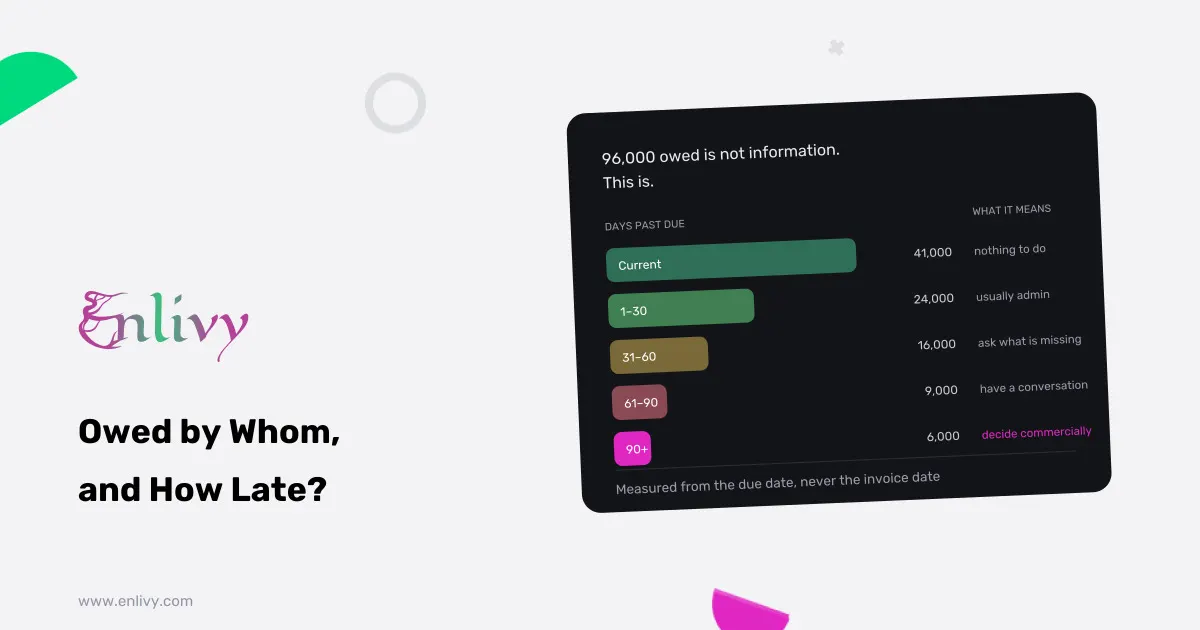
Watch the distribution, not the average. A DSO of 45 can mean everyone pays at 45, or half pay at 30 and a few pay at 90. Those need different responses, which is what the aged receivables report shows and the average hides.
Do not chase zero. The floor is your own terms. Getting below it means you are selling on terms nobody needed, which is a pricing conversation rather than a collections win.
What actually moves it
In rough order of effect, and only the first two are about chasing.
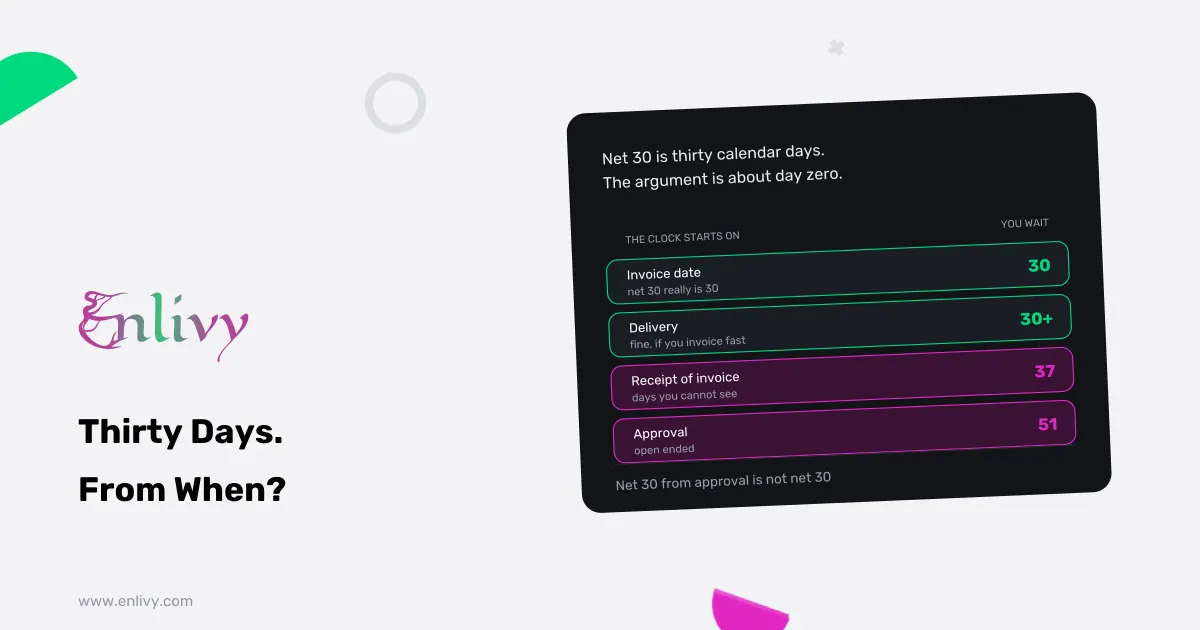
Invoice on time. The clock starts at issue. Invoicing a week late converts 30-day terms into 37 without anyone deciding to. For work you know is coming, scheduling the invoice so it is issued on a set date removes this entirely.
Remove the reasons an invoice sits. A missing purchase order number or the wrong recipient adds weeks, and neither is a collections problem. The fields that decide this are in how to write an invoice.
Set terms deliberately and cite them. Net 30 payment terms and the alternatives, including whether an early-payment discount is worth what it costs.
Chase on a schedule rather than on memory. The sequence that recovers payment without damaging the relationship is in what to do when an invoice is not paid.
Make paying easy. Full bank details, a link, and a portal where the client can find the invoice themselves instead of emailing you for a copy.
Where this sits in the wider chain
DSO is a measurement of one segment of the path from a signed agreement to money in the bank: the stretch between issuing an invoice and the payment landing. The full path, and the four points where it leaks, is the contract-to-cash workflow.
The number is downstream of decisions made much earlier. Terms agreed in the master service agreement, an invoice that matches what the client accepted, and a recurring arrangement that bills without anyone remembering all show up in it eventually.
Enlivy keeps each invoice linked to its payments and receipts, sold as separate packs, and with the Reports pack, whoever owns collections can report the figure on a schedule through team reports. You can start free with up to 5 invoices a month.
If you are comparing tools on the receivables side, the write-ups on QuickBooks, FreshBooks and Xero say where each of them wins.
Sources: DSO formulas and the countback method, industry benchmarks.