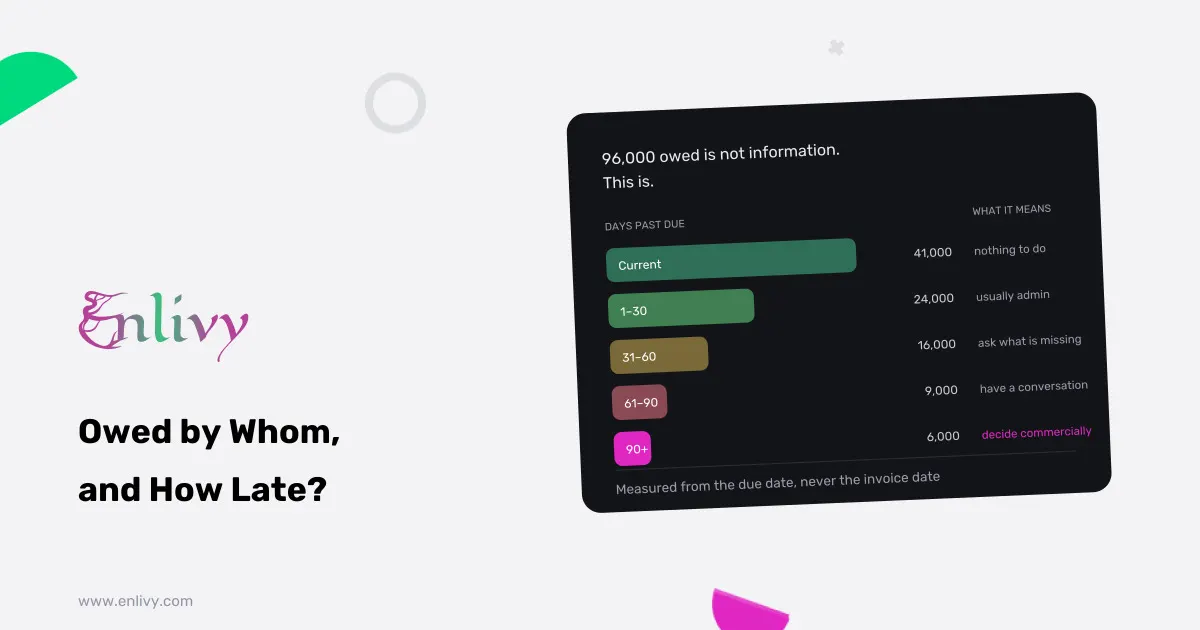
“We are owed 96,000” is not information. Owed by four clients or forty, due next week or last quarter, all changes what you should do this afternoon.
An aged receivables report answers that. It takes everything outstanding and sorts it by how long it has been overdue, which turns one number into a list you can act on.
The standard buckets
Nearly every system uses the same five, measured from the due date rather than the invoice date.
| Bucket | What it means |
|---|---|
| Current | Not yet due. Normal. |
| 1 to 30 days | Late, usually administrative |
| 31 to 60 days | Late enough to be deliberate or stuck |
| 61 to 90 days | Something is wrong and nobody told you |
| 90+ days | Collection risk, not a timing issue |
Some businesses split the last bucket into 91 to 120 and 120 plus. Worth doing when anything reaches there regularly, and a bad sign if it does.
The measurement point matters. Ageing from the invoice date instead of the due date makes everything on net 30 look 30 days late, and the report stops distinguishing between a client who is slow and one who is simply within terms.
What each bucket actually tells you
The buckets are not just severity. They describe different problems with different fixes.
Current is your pipeline of cash. If most of your balance is here, collections are working and the number to watch is your days sales outstanding rather than this report.
1 to 30 is almost always administrative. The invoice went to the wrong person, it is missing a purchase order number, or it arrived after their payment run. Nobody is refusing. A short factual note recovers most of this bucket, which is why the first step in chasing an unpaid invoice is a question rather than a demand.
31 to 60 means the first attempt did not work, or nobody made one. The cause is usually that the invoice is sitting in a queue nobody owns, or it was rejected by their system and you were not told.
61 to 90 means something is wrong that has not been said out loud. A dispute nobody raised, a contact who left, or genuine cash trouble. This bucket needs a conversation, not another reminder.
90+ is a different activity. The probability of collecting drops sharply, and the question changes from how to remind to whether to escalate, settle or write off.
Reading the shape, not the total
The total is the least useful number on the page. Four patterns are worth recognising.
Concentration. One client is 60 percent of the balance. That is not a receivables problem, it is a client-risk problem, and it deserves a different conversation than a reminder email.
A widening tail. The 61 to 90 bucket grew for three months running. Something in the process changed, and it usually predates the bucket by a quarter.
One client across several buckets. The same name in 1 to 30, 31 to 60 and 61 to 90 means every invoice you send them is late, consistently. That is a terms and pricing conversation, not a chasing one, and the payment terms in the agreement are where it gets fixed.
A stale 90+ that never moves. Same invoices, same amounts, quarter after quarter. Those are not receivables, they are decoration, and they inflate every metric computed from the balance.
Using it to estimate what you will not collect
The report has a second job beyond chasing: estimating the part of the balance that is not really money.
The method is to apply a percentage to each bucket, based on your own history of what eventually went bad. Illustrative percentages often look like this:
| Bucket | Assumed uncollectible |
|---|---|
| Current | 1% |
| 1 to 30 | 5% |
| 31 to 60 | 15% |
| 61 to 90 | 30% |
| 90+ | 50% |
Applied to your balances, the total is your allowance for doubtful accounts.
Two cautions. Those figures are an illustration, not a standard: derive yours from what actually happened in your business, because a consultancy with five long-standing clients and an agency with two hundred small ones have nothing in common here. And the estimate is only as good as the ageing, which is only as good as the reconciliation underneath, which is the argument in account reconciliation.
What to do with each bucket, concretely
A short operating rule, so the report produces action rather than anxiety.
Current. Nothing. Do not chase early; it reads as distrust and trains nobody.
1 to 30. One factual message to the person you deal with, asking whether it reached finance, with the invoice attached again. Most of this bucket clears here.
31 to 60. Ask what is missing rather than when they will pay. The question surfaces a purchase order requirement or a rejected document, which is actionable, whereas the other one produces a date that slips.
61 to 90. Escalate in writing, to somebody in finance, citing the invoice number, the amount, the due date and the term in the signed agreement. Not a threat, a record.
90+. Decide commercially. Stop new work, agree a payment plan, or hand it on. Whatever you choose, put it in writing and stop sending reminders into a void.
The one habit that matters more than any of the above: stop chasing the moment a payment lands. Nothing costs more goodwill than a reminder for an invoice settled four days ago, and it only happens when matching lags, which is what bank reconciliation prevents.
Preventing the report from filling up
Most of what lands in the late buckets was decided before the invoice went out.
Invoice on time. A week’s delay in issuing is a week added to every bucket downstream, and scheduling the invoice so it is issued on its date removes the possibility.
Make the invoice acceptable first time. Missing purchase order, wrong entity, wrong tax treatment. Each is a rejection you may not hear about. The list of fields that decide this is in how to write an invoice.
Send it to the right person. Established at contract signature, not at the due date.
Let the client serve themselves. A portal where they can find the invoice and pay by card through your own Stripe account removes a category of delay that is nobody’s fault.
Bill on a predictable rhythm. Invoices arriving on the same day each month enter the client’s payment run. Invoices arriving whenever someone remembers get handled individually, which is slower.
Where this sits in the wider chain
Aged receivables is the diagnostic for one stretch of the path from agreement to cash: what happens between issuing an invoice and the money arriving. The full path is the contract-to-cash workflow.
The report is a symptom reader. Its causes sit upstream in the terms you agreed, the proposal the invoice should have inherited from, and whether recurring work bills on schedule. Its consequences sit downstream in the export your accountant works from.
Enlivy keeps each invoice linked to its payments and receipts and sells the parts as separate packs. You can start free.
If you are comparing tools on receivables specifically, the write-ups on QuickBooks, Xero and FreshBooks cover where each of them stops.
Sources: aging buckets and the allowance method, how to use an aging report.