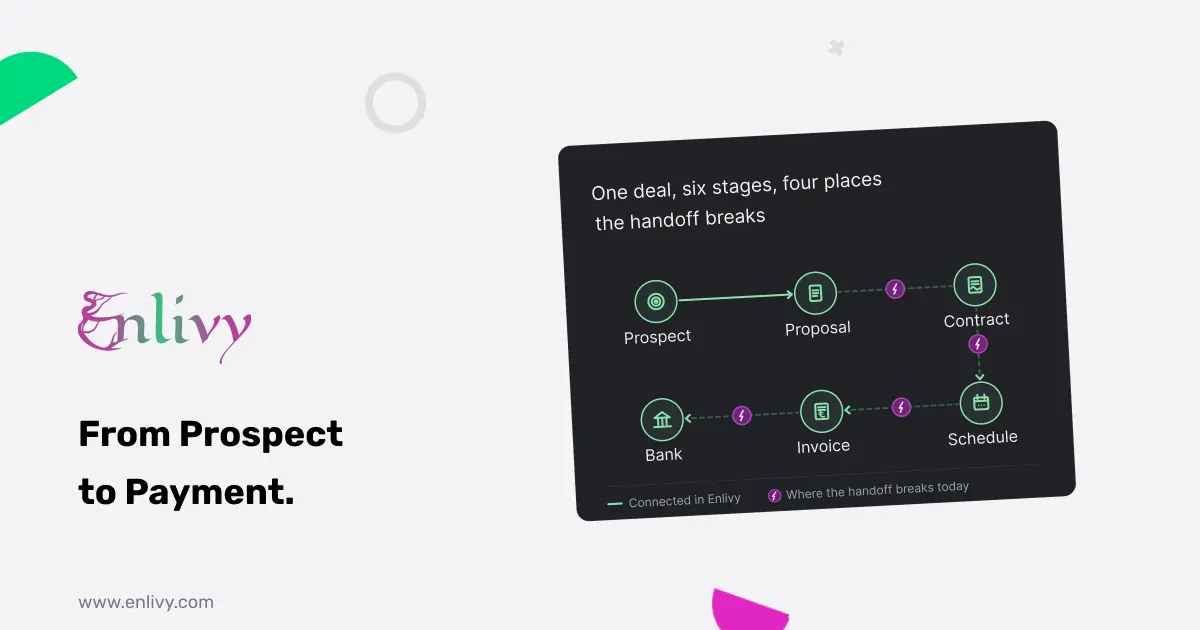
Every service business runs the same chain. A lead becomes an opportunity, the opportunity becomes a proposal, the proposal becomes a signed contract, the contract becomes an invoice, the invoice becomes a payment, and the payment eventually matches a line on a bank statement.
That chain is the contract-to-cash workflow. Most businesses can describe it in one breath, and almost none of them can follow a single deal through it without opening four different tools.
The gap between those two facts is where the money goes.
The handoffs
The workflow is not a list of steps. It is a chain of handoffs, and a handoff is where work gets lost:
- Lead to qualified opportunity
- Opportunity to priced proposal
- Accepted proposal to signed contract
- Signed contract to billing arrangement
- Billing arrangement to issued invoice
- Payment received to reconciled bank line
Steps are cheap. Handoffs are expensive, because each one is a moment where a human copies something from one system into another and has the chance to get it wrong.
Where it actually breaks
In our experience the failures cluster at four points, and they are not the ones people expect.
Handoff 3: the accepted proposal that becomes a different contract
The client says yes to a scope and a number. Somebody then opens a Word template and rebuilds that scope from memory, or from an email thread, and the contract quietly ships with last quarter’s payment terms.
Nobody notices until the invoice is disputed. The fix is that the accepted proposal should become the contract rather than inform it, which is what turning a won opportunity into a proposal the client accepts is for. In Enlivy, the accepted proposal creates the invoice with the lines the client agreed to and, when its billing package has a contract template, generates the contract from it, so nothing is rebuilt from memory. The four specific ways the two documents drift apart are worth reading in full if this is your weak link: from accepted proposal to paid invoice.
Where the client is a repeat one, the rebuild is avoidable structurally rather than by being careful: a master service agreement settles the terms once so each engagement attaches as a short statement of work instead of a fresh negotiation.
Handoff 4: the contract that never becomes a billing arrangement
This one is silent and it is the most expensive.
A retainer is agreed in March. Someone remembers to invoice it in April, May and June. In July that person is on holiday and nobody invoices at all. The client does not call to remind you.
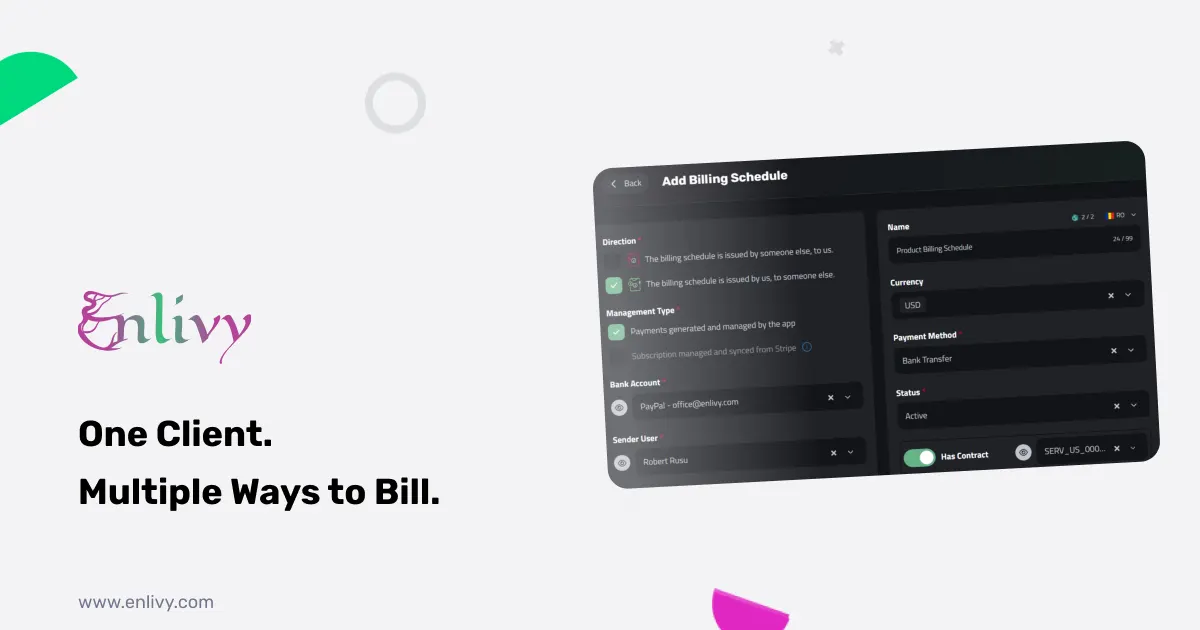
A contract is a promise about money that recurs, so it should create the recurring arrangement at signature, not a note in somebody’s calendar. That is the job of a billing schedule that tracks every retainer and payment plan as a live relationship rather than a series of unrelated invoices. The setup that stops the leak, including which kind of retainer you are actually selling, is covered in how to bill a retainer client.
Handoff 5: the invoice that gets rebuilt every month
Even where billing is remembered, it is often re-entered. Same client, same line items, same rate, typed again.
The work is not the typing, it is the drift. Month four has a slightly different description, month seven has last year’s rate, and by the annual review the client has twelve invoices that do not agree with each other. A scheduled invoice is issued once, on the date you set; for the monthly repeat, a billing schedule on the Billing Schedules pack issues each cycle’s invoice from the same lines, which removes both the labor and the drift.
Whether you manage that arrangement or let the client manage it themselves is a genuine fork, and picking the wrong side of it costs either revenue or hours: recurring billing for service businesses covers both models.
Handoff 6: the payment nobody can match
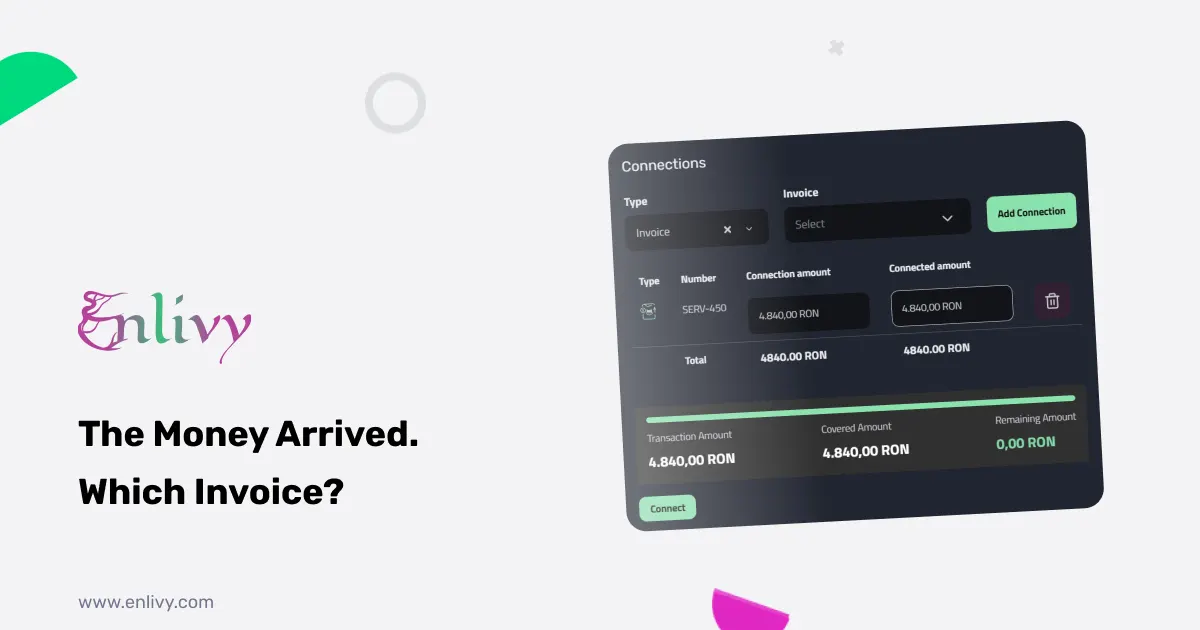
Money arrives. Which invoice was it for? Partial payments, bundled transfers and clients who pay two invoices with one round number turn this into detective work at month end.
It stops being detective work when you link each bank transaction to the invoice or receipt it settles, and when the accounts themselves sync every few hours with the Banking pack rather than arriving as a monthly CSV. The five cases that make this hard, from partial payments to currency, are in matching payments to invoices.
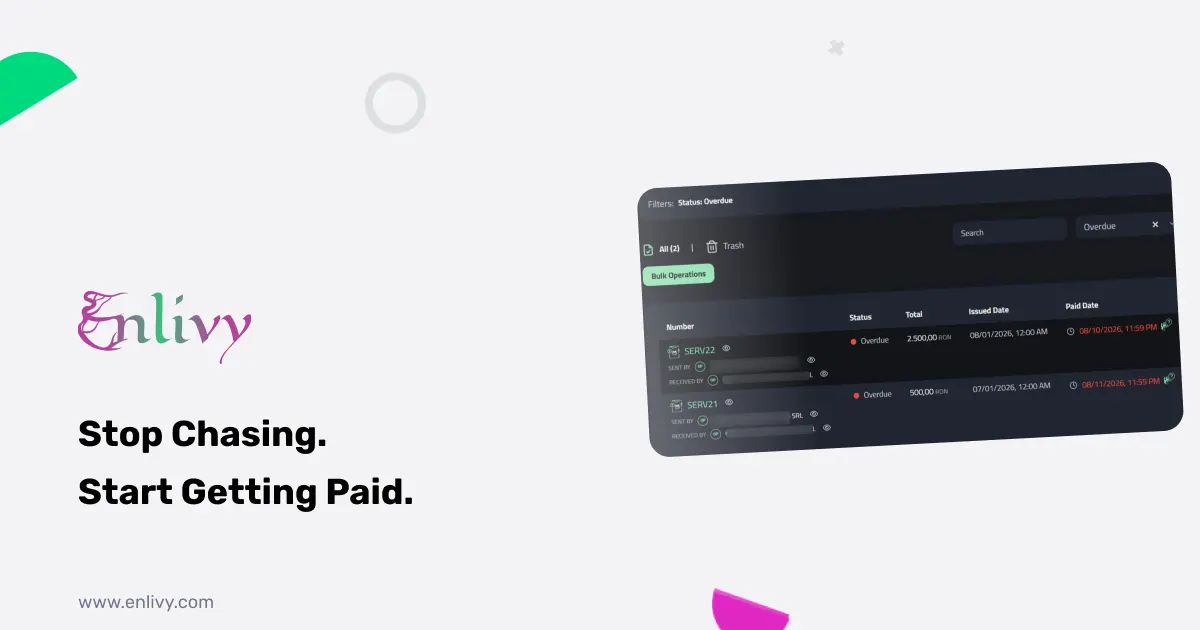
And when the money simply does not arrive, the fix is rarely a firmer email. Chasing an unpaid invoice starts with working out which of four things went wrong, because three of them are not refusals.
Why the usual toolset guarantees the gaps
The reason these handoffs break is structural, not managerial.
A typical service business runs a CRM for the pipeline, a document tool for proposals, an e-signature service for contracts, an invoicing tool for billing, and an accounting package at the end. Five products, five databases, five ideas of who the client is.
Every handoff in the list above is a boundary between two of those products. The workflow does not break because people are careless. It breaks because there is no shared record for a deal to travel along, so every boundary requires a human to carry it across by hand.
This is also why adding a sixth tool rarely helps. Integrations move data between databases; they do not remove the boundaries.
What closing the gaps actually requires
Three properties, and they are worth stating plainly because most tools have one or two.
Linked records from first contact to reconciled payment. The opportunity, the proposal, the contract, the schedule, the invoice and the payment have to point at each other, so any one of them leads to the rest. That is what a sales pipeline with invoicing attached to it means in practice, and it is the difference between a CRM and a system that follows the deal to the bank.
Recurring work that runs without being remembered. Anything that repeats on a cadence should execute on that cadence. If a person has to remember it, it will eventually be forgotten, and the month it is forgotten is pure lost revenue.
Compliance at the end of the chain, not bolted on after. In the EU this is no longer optional. An invoice is not finished when it is sent to the client; it is finished when it has been transmitted through the right e-invoicing network. Romania already requires it through ANAF, Belgium went live in January 2026, and Germany follows in 2027. A workflow that treats this as an afterthought will break the month the mandate arrives. Enlivy sends the invoice to ANAF e-Factura when a Romanian company invoices a Romanian client, and for other countries it exports a PEPPOL BIS 3.0 file or a national e-invoice XML that you submit yourself. The documents themselves have rules worth knowing before you need them: what belongs on the invoice in how to write an invoice, and how to correct one you cannot delete in credit note.
The parts of the chain, and what each one owns
For a service business, the chain maps to a specific set of jobs:
- Prospects holds the pipeline, so a deal exists as a record before it is worth money.
- Proposals turns the won opportunity into something itemized the client can accept and pay from.
- Contracts carries the agreement and the signature. If several people sign, each signer signs from their own link, in any order, and what makes an online signature hold up is worth understanding before you rely on one.
- Billing Schedules turns the agreement into a recurring arrangement with a visible balance.
- Products keeps what you sell defined once, so proposals and invoices quote the same thing.
- Invoices issues the document, and the event trail records who changed what if a total is ever questioned.
- Taxes resolves the right rate for the client’s country and status rather than leaving it to whoever is typing.
- Bank Transactions closes the loop by matching money to documents.
Around the spine sit the things that keep it honest: receipts for what was actually paid, reports for what the team is doing, and a client portal so the client can answer their own questions instead of emailing you.
How long the chain should take
A useful test. Pick a deal you closed last month and time how long it takes to answer these three questions:
- What exactly did the client agree to, in writing, with a date?
- Which invoices has that agreement produced, and which are unpaid?
- Which bank lines settled them?
If all three take under a minute, your workflow is connected. If any of them requires opening a second system or asking a colleague, you have found your broken handoff.
Where to start if the chain is broken today
Do not start by replacing everything. Start at handoff 4, the contract that never becomes a billing arrangement, because it is the one that silently loses revenue rather than just wasting time. Every unbilled month is money you will never invoice.
Then work outward: connect the billing arrangement to the invoice, then the invoice to the payment, then the proposal to the contract.
Agencies are a partial exception to that order. Where a business fronts money on a client’s behalf, the pass-through costs leak faster than the retainers do, and quote to cash for agencies covers the four places agency billing breaks that a general chain does not reach.
If you want to see what the whole chain looks like when it is one system, Enlivy runs it end to end, and the pieces are bought as separate feature packs so you can close one handoff at a time rather than buying a suite. Most teams compare it against what they already run, and the comparisons against the usual tools name where each of those wins as well as where it stops.
You can also start free and take a single real deal from proposal to invoice before deciding anything. The recurring billing and bank sync steps need the Billing Schedules and Banking packs.