A retainer is the best commercial arrangement a service business can have, and the one most often agreed on a handshake. The work starts, the money arrives monthly, and nobody writes down what happens when the client uses half the hours, or none, or twice as many.
Then month five arrives and somebody is annoyed.
A retainer agreement is a short document that answers three questions before they become expensive: what the client is buying, what happens to what they do not use, and how either side gets out.
First, decide what you are actually selling
The agreement follows from this, and most disputes trace back to it never having been said plainly.
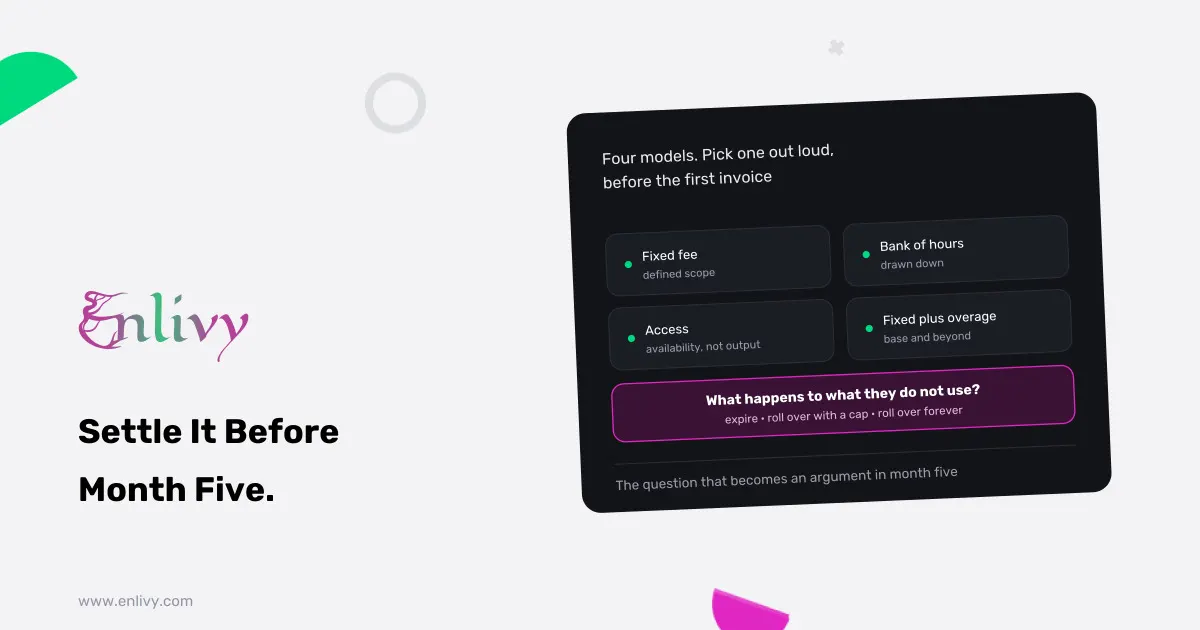
Fixed fee for a defined scope. Same amount each period for an agreed set of outputs. Simplest to write, easiest to argue about when the scope drifts.
A block of hours. The client buys capacity and draws it down. Simple to bill, harder to track, and the roll-over question decides whether it works.
Access or availability. The client pays to have you reachable, with priority, rather than for output. Common in advisory work. Clean commercially, but only defensible if the agreement defines what availability means: response time, hours covered, what counts as a request.
Fixed fee plus overage. A predictable base, with anything beyond it billed separately. The most honest model for most agencies and the one demanding the most discipline, since overage has to be captured as it happens rather than reconstructed at month end.
Name the model in the agreement in one sentence. Half of all retainer friction disappears at that sentence.
The clauses that prevent the arguments
What unused capacity does. The single most contested point. Hours can expire at period end, roll over with a cap, or roll over indefinitely. Any of the three is fine; leaving it unsaid is not. Expiry is cleaner for you and needs to be visible to the client from the start rather than raised in month four.
What happens when they go over. Overage rate, whether it needs approval first, and the threshold at which you stop and ask. A retainer with no overage clause quietly turns into unpaid work, because refusing feels like a bigger deal than absorbing it.
Scope boundaries. What the retainer covers and, more usefully, what it does not. Two or three named exclusions save a quarter of arguments.
Payment timing. Retainers are normally billed in advance, and the agreement should say so. In advance means the money arrives before the work; in arrears means you are financing the client every month. Either is workable, but this is the clause that decides your cash position, and the payment terms in the underlying agreement should back it up.
Term and notice. A minimum term if there is one, then the notice each side must give. Thirty days is common; sixty is normal for larger commitments. This is also where auto-renewal lives, and renewal clauses deserve more attention than they get because the notice window is usually earlier than people assume.
Price review. When the rate can change and with how much notice. Without it, raising a price becomes a renegotiation instead of a scheduled conversation.
Retainer, MSA or SOW?
They stack rather than compete.
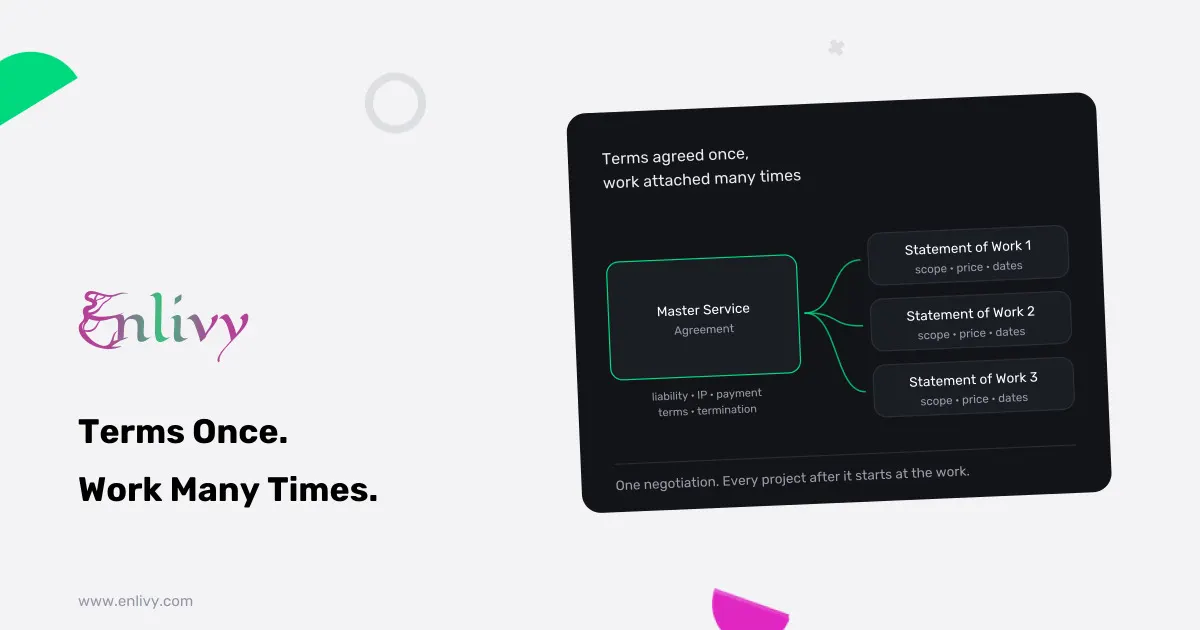
A retainer agreement is effectively an MSA with a recurring commitment attached. If you already have an MSA with the client, the retainer can be a short document under it, saying only the amount, the cadence, the capacity and the notice.
If the work is a defined project rather than ongoing capacity, you do not want a retainer at all. You want a statement of work with milestones. Retainers describe availability over time; SOWs describe deliverables.
The mistake worth avoiding is a retainer written like a project: fixed deliverables, fixed dates, monthly billing. That is a project on an instalment plan, and it will be argued about as one.
Make the agreement produce the billing
The gap between a signed retainer and the money is administrative, and it is where the revenue actually leaks.
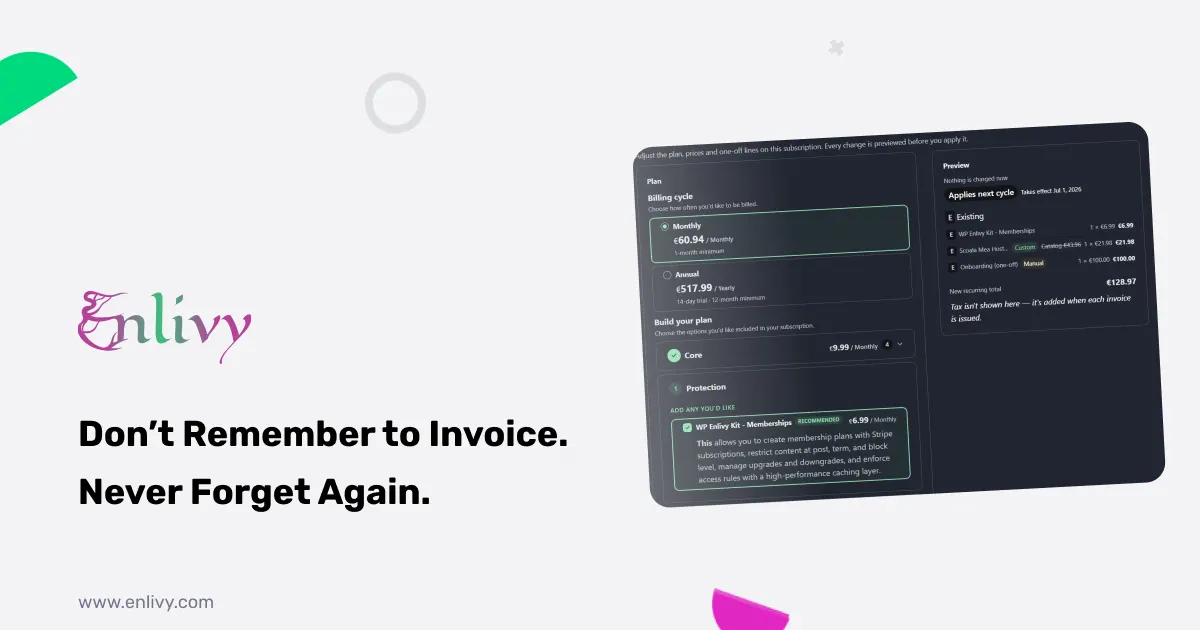
The rule is that signature should create the billing arrangement, not a note in someone’s calendar. A calendar reminder depends on a person being at work; an arrangement does not. What that looks like in practice, meaning a cadence, a running balance and invoices attached to the relationship rather than scattered, is covered in how to bill a retainer client.
Define the retainer once as a line item in your product catalog so the description does not drift across twelve invoices. Where the offer is standardized enough to be bought without negotiation, the client can manage the subscription themselves on the Billing Schedules pack, changing tier in the portal if you allow it, instead of emailing you. Most service businesses need both shapes, a handful of negotiated retainers alongside a long tail of standard plans. That split is the subject of recurring billing for service businesses.
Signing it, and finding it later
A retainer is a document you will need to cite. When the client asks in month nine what they are entitled to, the answer should take seconds.
Send it for electronic signature rather than printing it, and if the client needs more than one approver, give each signer their own link. Keep the signed version against the client in contracts so it is not living in an inbox, and let the client see their own documents and balance so the routine questions never reach you.
This is a commercial framework, not legal advice. Retainers involving regulated work, exclusivity or unusual liability are worth a lawyer’s review.
Where this sits in the wider chain
A retainer agreement is the point where a relationship becomes recurring revenue, and it is the handoff where money disappears most quietly in the contract-to-cash workflow.
Downstream, an unpaid month compounds faster than people expect on recurring revenue, and what to do when the invoice is not paid is worth reading before you need it. Knowing which months actually landed depends on matching payments to invoices, which on a retainer is far easier when twelve invoices belong to one arrangement.
Enlivy keeps the agreement, the schedule and its invoices linked, sold as separate packs. You can start free with the agreement itself; the schedule needs the Billing Schedules pack.
For teams weighing tools built around retainers specifically, the comparisons against Bonsai, HoneyBook and Ignition say where each of them wins.