Every argument about scope is really an argument about a document nobody wrote carefully.
A statement of work is the document that says what is being delivered, by when, for how much, and how everyone will know it is done. It is short by design. When it gets long, it is usually because terms that belong in the contract have leaked into it.
SOW or contract?
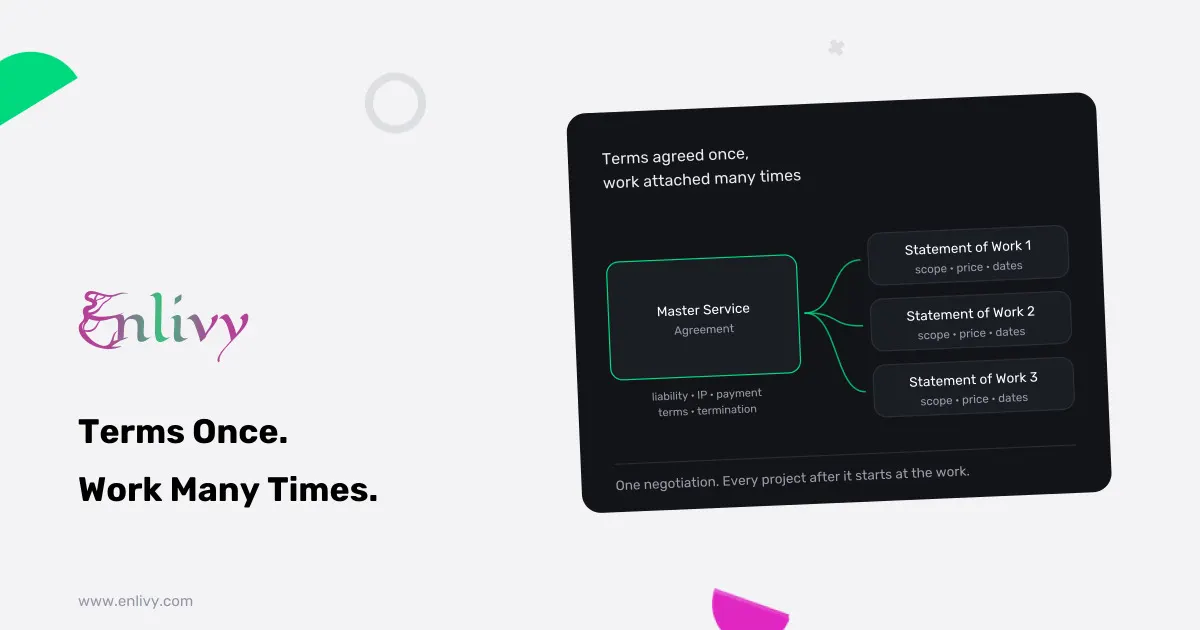
They are not alternatives. In a well-structured relationship there is one master service agreement and many statements of work hanging off it.
The MSA is about the relationship: liability, IP, confidentiality, payment terms, how either side leaves. The SOW is about this piece of work and nothing else.
A SOW that repeats the liability cap is a SOW that will be negotiated by the client’s legal team, which defeats the point. The reason to separate them is speed: terms once, work many times.
If there is no MSA in place, the SOW has to carry the legal terms too, and at that point it is simply a service contract with a different name. That is fine for one-off work. It stops being fine the third time you do it.
What belongs in it
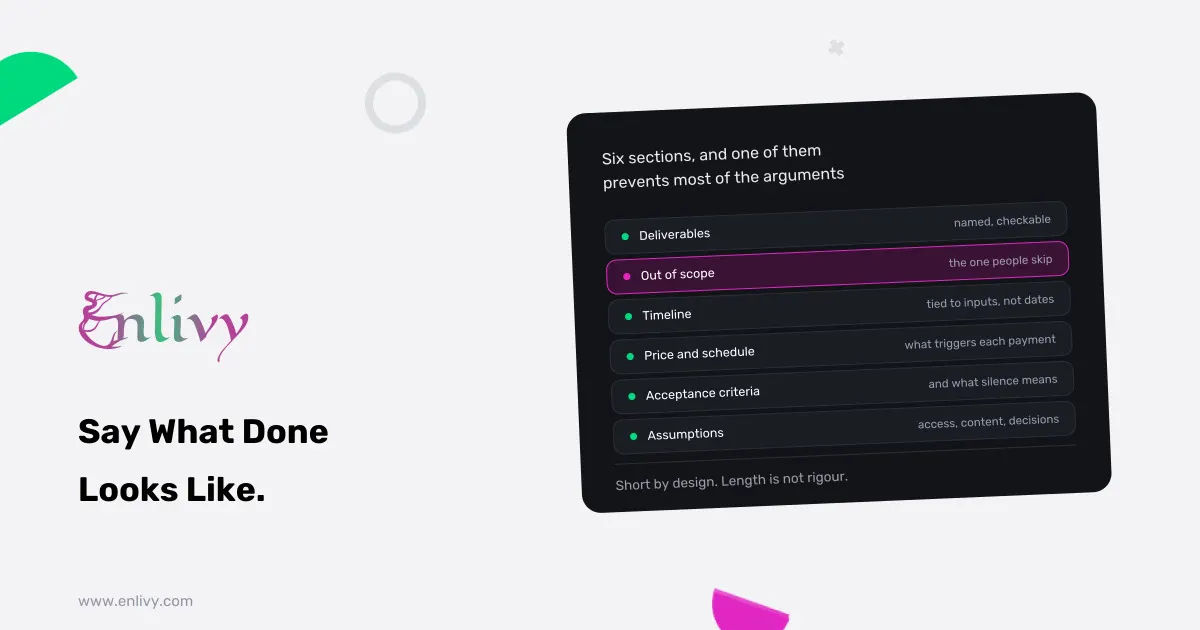
Six sections cover nearly every engagement.
Deliverables. Specific enough to be checked off. “Brand identity” is not a deliverable. “Primary logo, two secondary marks, colour and type system, and a 12-page usage guide, delivered as source files and PDF” is.
Out of scope. The section most people skip and the one that prevents the most disputes. Naming three things the client might reasonably assume are included, and saying they are not, costs one sentence and saves an argument.
Timeline and milestones. Dates, and what each date depends on. Most slipped timelines are caused by the client, not the supplier, so tie the dates to inputs: “wireframes delivered five working days after brand assets are received” survives a delay in a way that a fixed calendar date does not.
Price and payment schedule. The amount, what triggers each payment, and the currency. Payment terms, meaning net days and late interest, stay in the MSA.
Acceptance criteria. How the client signals that a deliverable is accepted, and what happens if they say nothing. A deemed-acceptance clause (“accepted if no written objection within five working days”) is the difference between finishing a project and waiting indefinitely for a reply.
Assumptions. What you are relying on: access, content, a named decision-maker, a review turnaround. If an assumption fails, the timeline moves, and having written it down makes that a fact rather than an argument.
The two ways it fails
Too vague to enforce. “Ongoing marketing support” describes nothing. Six months later both sides genuinely believe different things were promised, and neither is lying. Vagueness feels friendly at signature and is expensive later.
Too long to be useful. A forty-page SOW that restates the contract gets read by lawyers, delays signature by three weeks, and still fails to say when a deliverable counts as accepted. Length is not rigour.
The test is whether someone who was not in the sales conversation can read the SOW and say what is owed, when, and for how much. If they cannot, it is not finished.
Change requests, before you need them
Scope changes. That is normal, and a SOW that assumes otherwise is the reason change becomes conflict.
Write the mechanism in: who can request a change, who prices it, and how it is approved. Then use it. The most common failure is not the absence of a change process but the habit of absorbing “small” changes informally until the project is thirty percent bigger than the one that was priced.
A change large enough to alter price or date should produce a written record rather than a Slack message. Depending on what is changing, that is either a new SOW or an amendment to the existing one, and knowing which is which keeps the paperwork navigable a year later.
Where a SOW comes from
It should not be written from scratch. It should be what the client already accepted, turned into a document.
If the pricing lives in a proposal and the services live in a product catalog, then the SOW inherits its line items rather than re-deriving them. The description of “monthly retainer” stops drifting between the proposal, the SOW and the invoice, because all three cite the same record.
That inheritance is the whole subject of going from accepted proposal to paid invoice, and it is where most of the operational value sits. The legal quality of your SOW matters less than whether the invoice matches it.
Signing it
A SOW under an existing MSA usually needs one signature on each side, which makes it fast. That speed is the reason the structure exists, so do not lose it by printing and scanning.
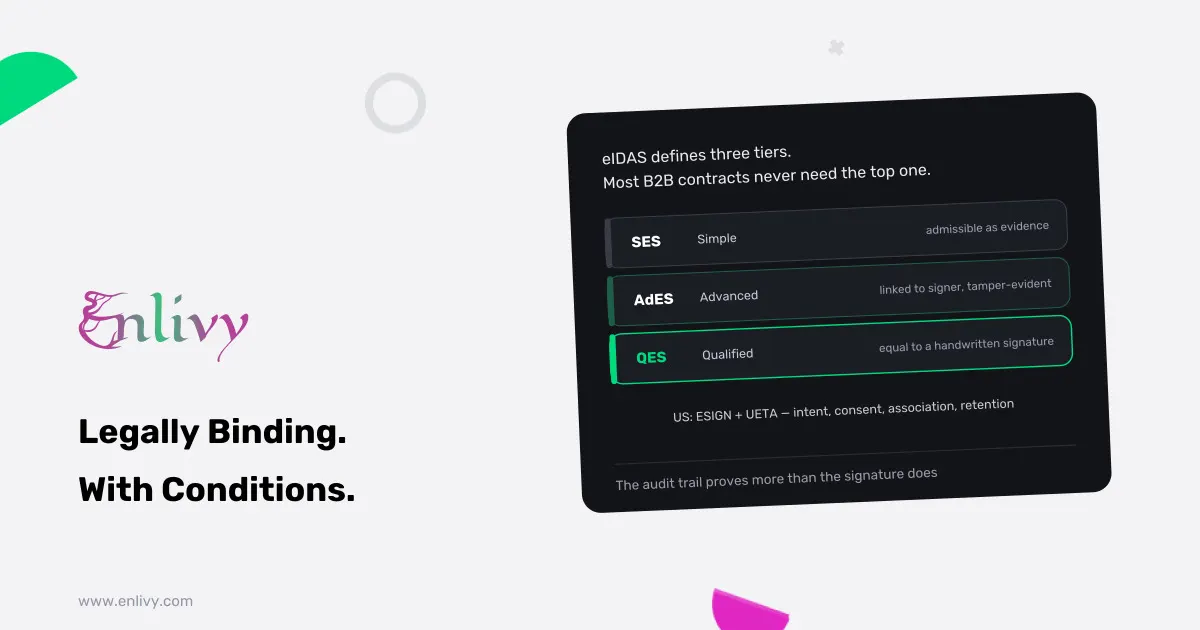
Sending it for electronic signature keeps the turnaround in hours. Where a client needs several approvals, giving each signer their own link beats chasing one attachment around. And if anyone on the client side asks whether an electronic signature is enforceable, ESIGN and eIDAS settle it.
Signed documents also need to be findable later. A SOW that exists only in an inbox is one you cannot cite when the dispute arrives. That is why the signed version belongs against the client record in contracts, and why letting clients find their own documents removes a surprising amount of email.
Where this sits in the wider chain
The SOW is one link in the path from a won deal to money in the bank. Upstream is the pipeline and the accepted proposal; downstream is the invoice, the payment and the reconciliation that proves it. The full path, and the four places it leaks, is the contract-to-cash workflow.
For recurring work the SOW gives way to a standing commitment, which is what a retainer agreement covers, and the billing side of that is a billing schedule rather than a series of unconnected invoices.
Enlivy links the proposal, the contract and the invoice and sells the pieces as separate packs. You can start free and run one engagement through end to end.
If you are choosing between tools for this specifically, the comparisons against PandaDoc, Bonsai and Ignition say where each of them wins.