The second project with a client should be faster to start than the first. In most service businesses it is not, because the whole contract gets renegotiated from scratch: liability, IP, payment terms, notice periods, all of it argued a second time by people who already agreed on them once.
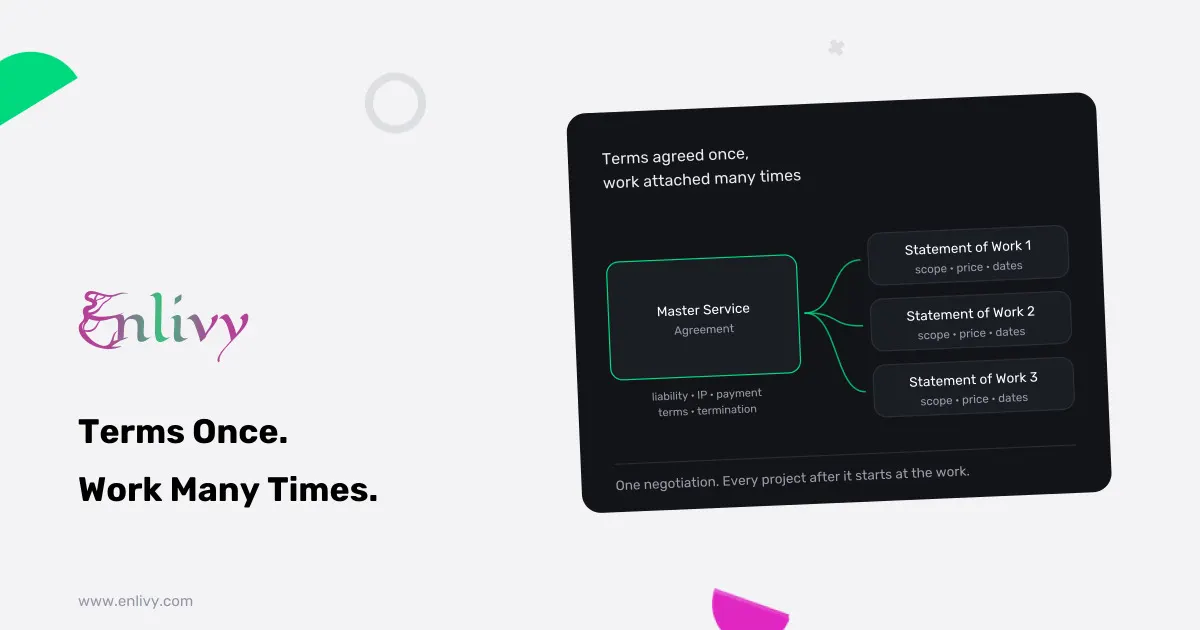
A master service agreement exists to stop that. You settle the terms of the relationship once, then each new piece of work attaches to it as a short document about the work itself.
That is the whole idea. The value is not in the legal language, it is in never having that conversation again.
The two-document structure
An MSA is half of a pair, and it only works as a pair.
The MSA holds what does not change. Who the parties are, how liability is limited, who owns the output, how disputes are handled, how either side ends the relationship, what confidentiality covers.
The SOW holds what changes every time. The deliverables, the timeline, the price, the acceptance criteria, the specific people involved. The statement of work is a separate document precisely so it can be short, specific and signed quickly.
Signed once, the MSA turns every subsequent engagement into a one-page document instead of a negotiation. That is the return.
What belongs where
This is where most agreements go wrong, and the failure is symmetrical: terms in the wrong document either get renegotiated when they should not, or never get agreed at all.
| Belongs in the MSA | Belongs in the SOW |
|---|---|
| Limitation of liability | Deliverables and scope |
| Intellectual property and licensing | Timeline and milestones |
| Confidentiality | Price and payment schedule |
| Payment terms (net days, late interest) | Acceptance criteria |
| Termination and notice | Named team or roles |
| Governing law and jurisdiction | Assumptions and exclusions |
| Insurance and subcontracting | Change-request process |
The line to hold: the MSA is about the relationship, the SOW is about the work. A price does not belong in an MSA. A liability cap does not belong in a SOW.
One exception worth writing down deliberately: payment terms live in the MSA, payment amounts live in the SOW. Net 30 is a property of the relationship. Twelve thousand dollars is a property of this project.
The clauses that actually decide outcomes
Most MSAs are long. Only a few clauses ever get read again after signature, and they are the ones that get read during a disagreement.
Intellectual property. Who owns what the work produces, and from what moment. The common trap is transfer on delivery rather than on payment. If IP passes on delivery, a client who has not paid still owns the output, and you have removed your own leverage. Say that transfer occurs on full payment.
Limitation of liability. Almost always capped at fees paid, often over the preceding twelve months. Without a cap, a small engagement can carry unlimited exposure.
Payment terms. The net period, what triggers the clock, who to invoice, and what happens when the date passes. Getting this wrong is not a legal problem so much as a cash-flow one, and chasing an unpaid invoice is far easier when the term is written down and citable.
Termination. Notice period, what happens to work in progress, and whether either party can leave for convenience or only for cause. If the client can walk with no notice, your pipeline is not real.
Confidentiality. Frequently the reason an MSA exists at all. Where the relationship needs a stronger or standalone version, a dedicated NDA covers the same ground with more room.
This is a general framework rather than legal advice. Anything with unusual liability, regulated data or cross-border enforcement is worth a lawyer’s hour before signature.
When you do not need one
An MSA is overhead. It earns that overhead only under repeat work.
Skip it for a single fixed project with no expected follow-on. A well-written service agreement covering that one piece of work is faster and no weaker.
Use it when you expect several engagements, when the client is large enough to have procurement, or when you are selling ongoing work. A retainer agreement is effectively an MSA with a recurring commitment attached, and it inherits the same structure.
The signal is repetition. The second time you copy last quarter’s contract and edit the scope, you already needed one.
Where the structure breaks operationally
The legal design is the easy half. Three things break in practice, and all three are administrative rather than legal.
Nobody knows which version is current. An MSA amended twice lives as three files, and the one attached to the last email is not necessarily the signed one. This is what amending a contract properly is for, and why the amendment belongs with the original rather than in a thread.
The SOW stops matching the invoice. The agreement is signed, then the invoice is typed by hand from memory and describes something slightly different. That gap is the single most common cause of a disputed invoice, and closing it is what letting the accepted proposal become the invoice does.
Signature stalls on the client side. Large clients need two or three approvals. Sending one PDF and hoping is how a week disappears; sending each signer their own signing link, so each can sign in any order, is how it does not. If you are wondering whether an electronic signature holds up at all, ESIGN and eIDAS answer that more clearly than most people expect.
Make the terms reusable, not retyped
If your MSA is a Word file that gets copied and edited per client, it will drift. Clause wording diverges, someone deletes a liability cap by accident, and two years later you cannot say what your standard terms are.
Drafting from a maintained template instead, so the standard clauses come from one place, means the version you consider current is the version that goes out. That is part of what contract management is for. The same discipline applied to how the work runs is what a playbook is for: the agreement says what you owe, the playbook says how it gets delivered, and guidelines hold the policies both refer back to.
Where this sits in the wider chain
An MSA is the top of the paperwork, not the end of it. It becomes a signed contract, which should become a billing arrangement, which becomes invoices, which become money. That whole path and the four places it leaks are laid out in the contract-to-cash workflow.
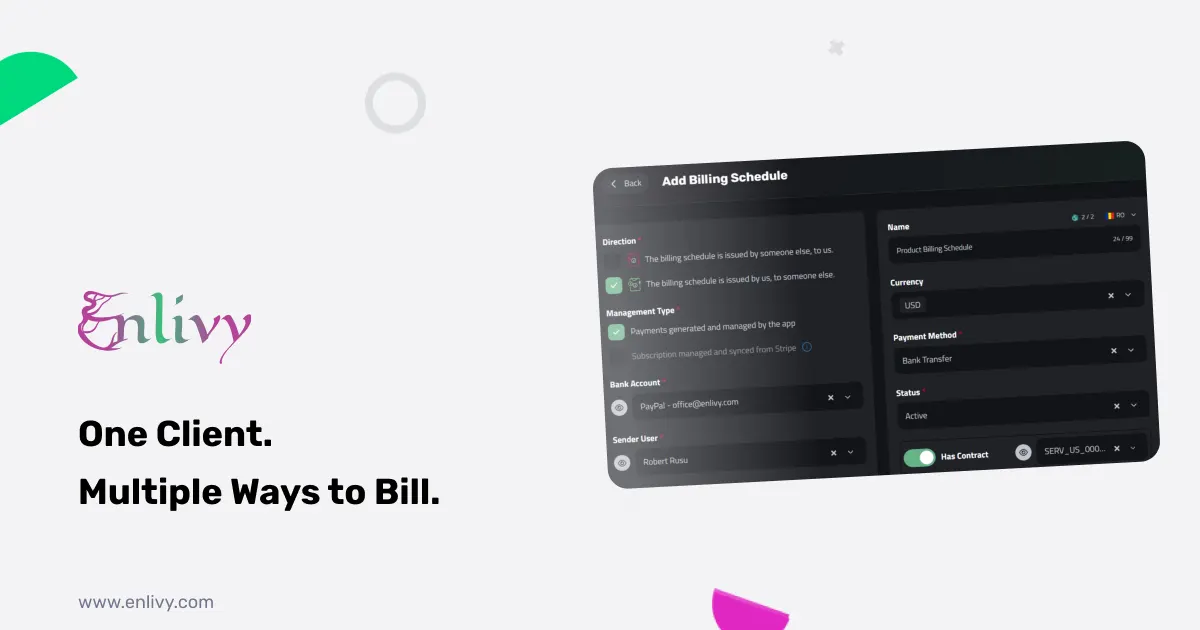
Upstream, the agreement should inherit from what the client actually accepted, which is what proposals are for rather than a template rebuilt from memory. Downstream, if the engagement recurs, the terms feed a billing schedule so the revenue does not depend on somebody remembering.
Enlivy runs the whole chain and sells it as separate packs, so you can put the contract side in place without replacing your invoicing. You can start free with a single agreement.
If you are currently doing this in a document tool bolted to a separate CRM, the comparisons against PandaDoc, HoneyBook and Dubsado each say where those win and where they stop.