A client wants the exact figure before they commit. Their finance team needs a document to raise a purchase order against. You want neither an informal email nor a real invoice sitting in your books for work nobody has approved yet.
That gap is what a proforma invoice fills. It looks like an invoice, states a firm price, and creates no accounting entry and no tax liability.
What it actually is
A proforma invoice is a commitment to a price, issued before the transaction is final. Latin for “as a matter of form”, which is the whole idea: it has the form of an invoice without the legal consequences of one.
That distinction matters more than it sounds:
It is not a demand for payment. A real invoice says money is owed. A proforma says this is what money would be if you proceed.
It creates no VAT or tax point. In most jurisdictions the tax obligation attaches to the real invoice. A proforma sits outside that, which is why it can be issued freely and revised without a correction document.
It does not enter your books. No receivable, no revenue, no sequence number consumed from your invoice series.
It is not legally binding on the buyer. It binds you to the price you quoted, for the period you stated. It does not oblige them to buy.
When to send one
Four situations account for nearly all legitimate use.
The client needs a document to get budget approved. Common with larger organisations, where procurement cannot raise a purchase order against an email. The proforma gives them a formal figure without you booking revenue for something unapproved.
Payment is required before the work starts. Deposits, prepayments, new clients without agreed terms. Send a proforma, receive the money, then issue the real invoice for the amount received.
The final amount is not certain yet. Shipping, variable quantities, work priced on estimate. The proforma states the expected total and is replaced once the actual is known.
Cross-border trade. Customs and freight forwarders frequently ask for a proforma before goods move. This is a goods use case rather than a services one, and the shipping-specific version is a different document with its own required fields.
What it has to say
There is no universal statutory format, precisely because it is not a tax document. What matters is that nobody can mistake it for one.
- The words “Proforma Invoice”, prominently. This is the part that stops it being treated as payable.
- Your details and the client’s, as they would appear on the real invoice
- A date of issue and a validity period, since a price held open forever is a liability
- Itemised lines: description, quantity, unit price, total
- Tax shown as it would apply, clearly marked as indicative
- Payment terms and method, if payment is expected before issue
- A reference number from a separate series, never your invoice sequence
That last point is the one people get wrong. Invoice numbering has to be unbroken and sequential for audit, so a proforma consuming a number leaves a gap you then have to explain. Keep a separate reference range. The reasoning behind sequence integrity is worth reading in full in how invoice numbering works.
Proforma, quote, invoice
Three documents, frequently confused, doing different jobs.
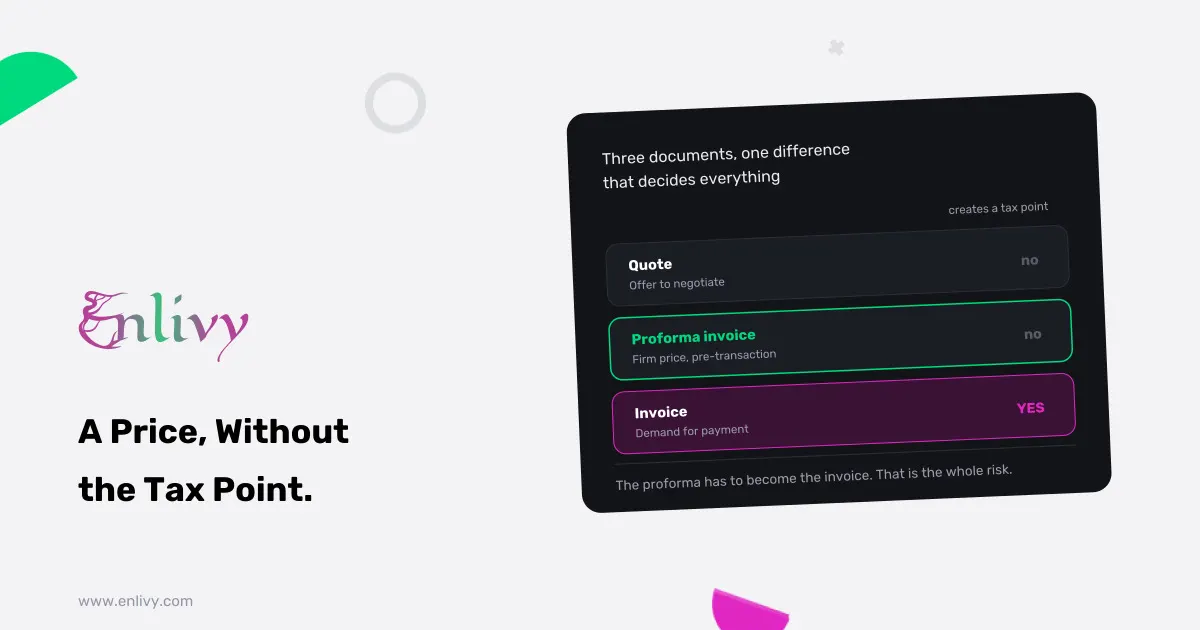
| Quote | Proforma invoice | Invoice | |
|---|---|---|---|
| Purpose | Offer to negotiate | Firm price, pre-transaction | Demand for payment |
| Binding on you | Usually not | Yes, for its validity period | Yes |
| Creates a tax point | No | No | Yes |
| Enters the books | No | No | Yes |
| Numbering | Own series | Own series | Sequential, unbroken |
| Typical trigger | Client is comparing | Client is committing | Work delivered or payment due |
A quote invites a decision. A proforma records one that has been made. An invoice collects on it.
Where the earlier stage is a detailed offer with line items the client accepts, that is a proposal rather than a quote, and the cleanest workflow lets that accepted document carry its lines all the way to the invoice. The four ways those two drift apart are covered in from accepted proposal to paid invoice.
The moment it has to convert
A proforma is temporary by definition. It becomes a real invoice at the earliest of:
Payment is received. In most systems the tax point is the earlier of supply or payment, so money arriving against a proforma usually triggers the obligation to issue the real document.
The goods or services are delivered. Supply has happened; the tax point follows.
The validity period expires. Not a conversion so much as an expiry. Either reissue at current pricing or let it lapse, but do not leave stale proformas outstanding, because a client will eventually pay one.
This is the step worth automating, because it is one operation rather than a retype: the proforma already holds the lines, the client and the tax position, so converting it produces the invoice with a number from the fiscal series and leaves the proforma behind as a record.
The failure mode is straightforward and common: payment arrives, everyone moves on, and the real invoice is never issued. You have the money and no tax document for it, which is a problem at the next filing rather than that afternoon. The invoice has to follow, and it has to be findable against the payment, which is what matching payments to invoices is about.
In the EU, conversion has a second step
Issuing the real invoice is not the end of it in much of Europe. A B2B invoice increasingly has to be transmitted as structured data through a network rather than emailed as a PDF. Enlivy sends it to ANAF eFactura when a Romanian organization invoices a Romanian client, and exports a PEPPOL BIS 3.0 file or national e-invoice XML for you to submit elsewhere.
The proforma itself stays outside that. It is not a tax document, so it does not go through the network. Only the invoice it becomes does, and the deadline runs from the real invoice, not from the proforma.
Getting the tax treatment right also matters at conversion. The proforma showed tax as indicative; the invoice states it as fact, and the correct rate depends on the client’s country and registration rather than on whoever is typing.
Getting it wrong, and how
Treating it as payable. If it does not say “Proforma” clearly, somebody’s accounts payable will process it, and now you have a payment against a document that does not exist in your books.
Using your invoice sequence. Breaks the unbroken series that audit depends on.
Never converting. Covered above, and the most expensive of the three.
Using it to delay revenue recognition. Issuing a proforma when the work is genuinely delivered, to move income into a later period, is not a grey area. The tax point follows the supply regardless of what document you chose to send.
Reusing it as a correction. If a real invoice was wrong, the fix is a credit note, not a proforma. A proforma cannot undo something already booked.
Where this sits in the wider chain
A proforma is one step in the path from an agreed price to money in the bank. Upstream sit the master service agreement and the statement of work that define what is being priced. Downstream is the invoice, the payment, and the reconciliation that proves it, laid out end to end in the contract-to-cash workflow.
If the arrangement repeats, the proforma stage usually disappears entirely: a billing schedule, on the Billing Schedules pack, issues the real invoice on a cadence, and the client sees what is owed in their portal rather than asking.
Enlivy runs the documents and the money in one place and sells the pieces as separate packs. You can start free.
For teams weighing this against a general accounting tool, the comparisons against QuickBooks, Xero and FreshBooks say where each of them wins.