A retainer is the best revenue a service business can have. It is predictable, it compounds, and it costs almost nothing to keep once it exists.
It is also the easiest revenue to lose, because nothing breaks when you forget it. A missed project invoice gets chased by the client. A missed retainer invoice is simply a month where you did the work for free, and the client has no reason to mention it.
First, decide which kind of retainer you are selling
The billing mechanics follow from this, and most disputes come from never having said it out loud.
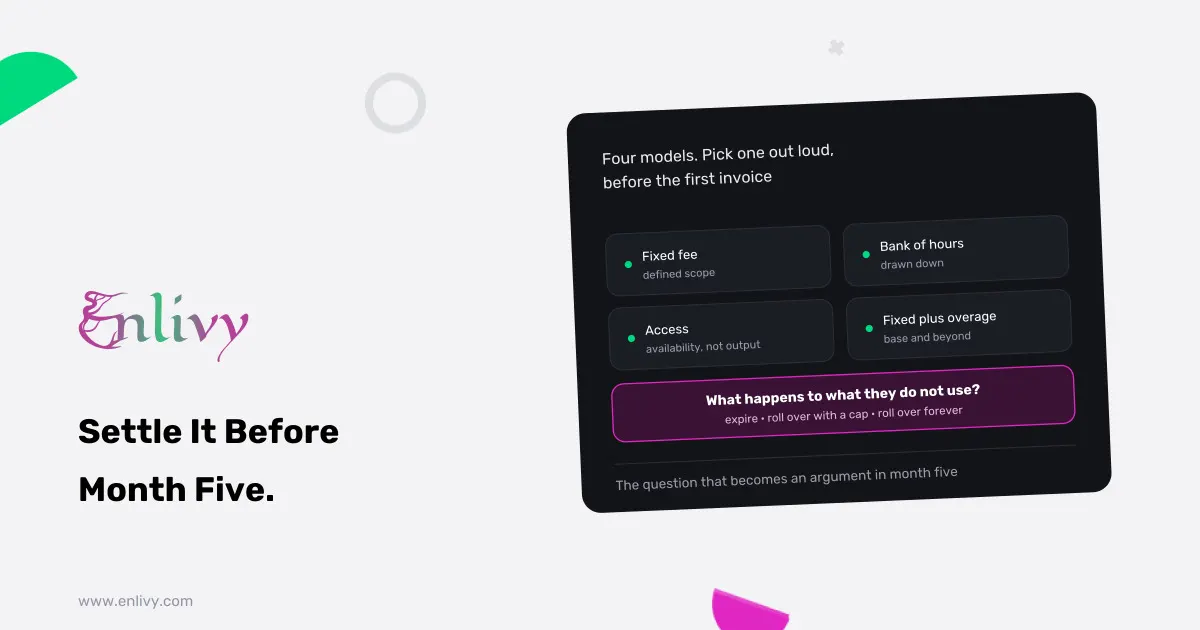
Fixed fee for defined scope. The client pays the same amount each period for an agreed set of deliverables. Simplest to bill, easiest to argue about when the scope drifts.
Bank of hours. The client buys a block of time each period and draws it down. Billing is simple; the tracking is where it goes wrong, because unused hours either expire or roll over and you must decide which before the first invoice, not after.
Access retainer. The client pays for availability rather than output. Common in advisory work. Clean to bill, but only defensible if the contract says what availability means.
Fixed fee plus overage. The base is predictable and anything beyond it is billed separately. The most honest model for most agencies and the one that requires the most discipline, since the overage must be captured while it happens rather than reconstructed at month end.
Write the model into the signed contract in plain terms, along with the period, the amount, what happens to unused capacity, and the notice required to cancel. The clauses that prevent the arguments, and the ones people leave out, are covered in what to settle in a retainer agreement. If several people on the client side need to approve, give each signer their own link, to sign in any order, rather than chasing a single PDF around by email.
The setup that stops the leak
There is one rule that prevents almost every retainer problem: the agreement should create the billing arrangement at signature, not a reminder.
A reminder depends on a person. A billing arrangement does not.
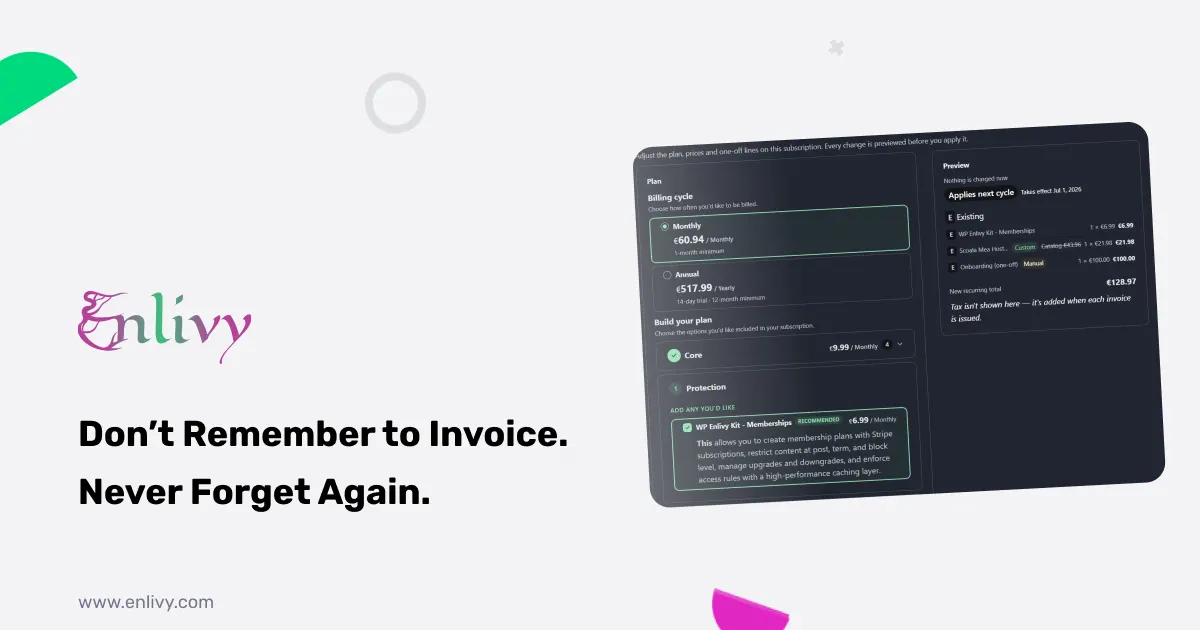
In practice this means the retainer exists as its own object with a start date, a cadence, an amount and a running balance, so at any moment you can see what has been billed, what has been paid and what is outstanding. That is exactly what a billing schedule is: a live record of a subscription, retainer or payment plan with its invoices and receipts attached, rather than a folder of documents that happen to share a client name.
Once the arrangement exists, the invoice should not depend on anyone remembering it. Scheduling an invoice sets the date once, and the invoice is issued on that date even if nobody logs in that morning.
Keep what you sell defined in one place
The second common failure is subtler. The retainer says “monthly strategy retainer” and each invoice describes it slightly differently, because each invoice was typed by hand.
Twelve months later the client has twelve descriptions of the same service and any of them can become an argument.
Define the retainer once as a product with its rate, and let the product catalog supply the line item to the proposal and the invoice alike. The description stops drifting because nobody is retyping it.
This also makes a price increase a real decision rather than an accident. You change the catalog rate deliberately, then apply it to each running schedule, instead of discovering that three clients are on last year’s number.
Let the client see their own balance
Most of the administrative cost of a retainer is not billing. It is answering “can you resend last month’s invoice” and “what did we agree to again”.
A client portal answers both without you being involved. The client signs in, finds their invoices and signed documents, and pays by card from there, through your own Stripe account. If they want to check something at 11pm on a Sunday, that is now their problem rather than your Monday.
For retainers sold as subscriptions on the Billing Schedules pack, the client can go further and manage the subscription themselves, changing tier where you allow it and updating their card, with no email to you.
Getting paid, and knowing that you were
An issued invoice is not revenue. Two things close the loop.
The invoice has to be a valid tax document wherever your client is. In the EU that increasingly means transmitting it through an e-invoicing network rather than emailing a PDF. Enlivy sends it to ANAF e-Factura when a Romanian company invoices a Romanian client, and for other countries it exports a PEPPOL BIS 3.0 file or a national e-invoice XML that you submit yourself. The right VAT treatment also depends on the client’s country and registration, which is not something to decide per invoice.
Then the payment has to be matched. When you link each bank transaction to the invoice it settles, a partial payment or a bundled transfer stops being a puzzle. If you would rather hear about it than find out at month end, Enlivy can post to Slack when an invoice is marked paid, with any paid pack.
A monthly check that takes two minutes
Once a month, ask three questions about every retainer:
- Did it bill on schedule?
- Was the amount the amount in the contract?
- Has it been paid, and against which bank line?
If answering takes longer than the check itself, the arrangement is being tracked in someone’s head. That is the thing to fix, not the invoice.
Where retainers sit in the bigger chain
Retainer billing is one handoff in the longer contract-to-cash workflow, and it is the handoff where money goes missing most quietly. The stages either side matter too: the pipeline that produced the deal and the proposal the client accepted are what the retainer should have inherited its terms from.
If your retainers currently live in a spreadsheet and a calendar reminder, the Billing Schedules pack holds each arrangement as one record, linked to its contract and invoices. Create your account, add the pack, and put a single client on it to see whether it survives contact with your actual billing.
Teams moving off a tool built for one part of this usually want to know how it compares. The comparisons against Bonsai, HoneyBook and Chargebee each say where those tools win, which is worth reading before you switch anything.