A signed contract is not frozen. Rates change, scope grows, the term runs out, someone leaves. The question is only whether the change is recorded properly or lives in an email thread that nobody can find in eighteen months.
The two instruments are an amendment and an addendum, and people use the words interchangeably. They are not the same, and picking the wrong one produces a document that is ambiguous about what it replaced.
The difference in one line
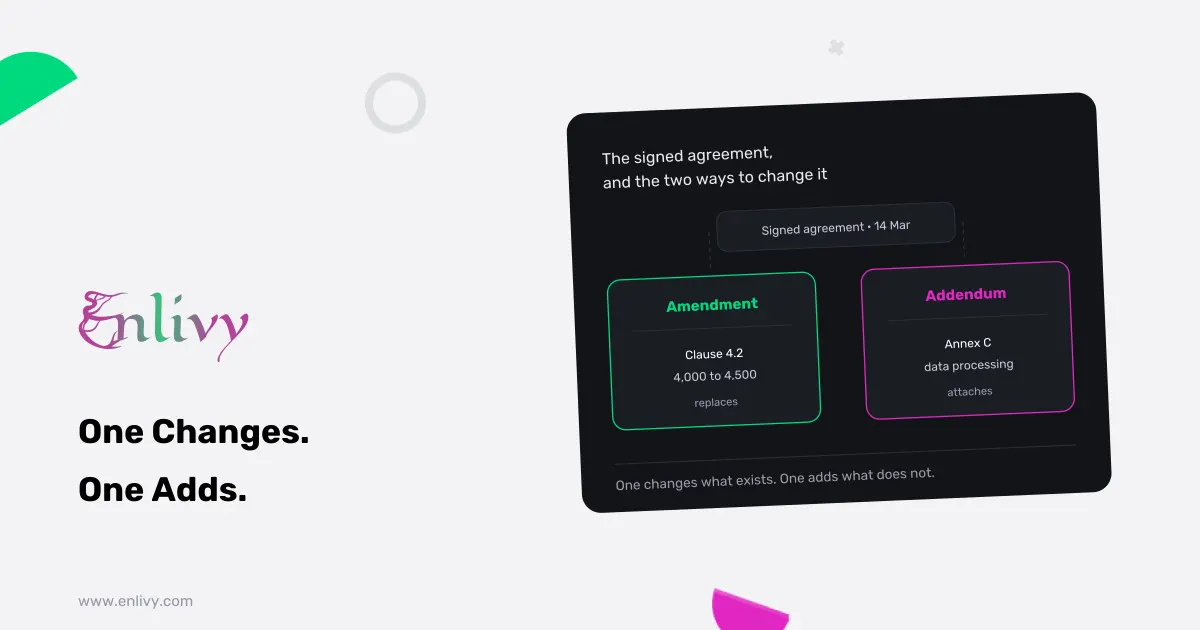
The amendment vs addendum question comes down to a single distinction: an amendment changes terms that already exist, an addendum adds terms that do not.
Raising a monthly fee from 4,000 to 4,500 is an amendment: a number in the original is being replaced. Adding a data-processing annex to a contract that never had one is an addendum: nothing is being replaced, something is being attached.
The practical consequence is what the document has to say. An amendment must identify precisely what it supersedes: the clause number, the old wording, the new wording, and the date the change takes effect. An addendum only has to say what it adds and confirm the rest of the agreement stands.
Get this backwards and you produce the worst outcome: a document that adds a new payment term without saying whether the old one is gone. Both are now arguably in force.
What either document must contain
Whichever you are writing, four things are not optional.
Identification of the original. Title, date, and the parties, exactly as they appear on the original. “The agreement between us” is not identification.
What changes, precisely. Clause reference and the replacement text. For an amendment, quote the original wording being removed. It reads pedantically and it ends arguments.
The effective date. Not the signature date. A rate change agreed in March that applies from April has two different dates, and only one of them decides what you invoice.
Confirmation of the rest. A line stating that all other terms remain in full force. Without it, the scope of the change is open to interpretation.
Then both sides sign it, with the same formality as the original. An amendment signed by one party is a request.
Renewal is where most money leaks
Termination clauses get read. Renewal clauses do not, and they cost more.
Automatic renewal rolls the contract into a new term unless someone gives notice. It favours whoever benefits from continuity, which for a service business is usually you. It cuts both ways though, because it binds you as well.
The trap is the notice window. A clause reading “renews annually unless either party gives 60 days’ notice” means the decision point is ten months into the year, not twelve. Miss it and you are committed for another full term, at last year’s rate. Every year a supplier discovers this the same way: by trying to leave in month eleven.
Two things follow. Put the notice date in a calendar the moment you sign, not the month it matters. And if you are raising prices, the renewal is the natural moment. An amendment timed to the renewal date is a normal commercial conversation, while a mid-term increase is a renegotiation.
Termination deserves the same attention in the opposite direction. For convenience or only for cause? What notice? What happens to work in progress and to fees already paid? A contract that can be ended without notice is not a commitment, and a pipeline built on those is not a forecast.
Amend, or write a new agreement?
There is a point where amending stops being sensible.
Amend when the change is contained: a rate, a date, a named contact, one clause. Two or three amendments over the life of an agreement are normal and keep the history readable.
Start fresh when the amendments outnumber the clauses they touch, when the commercial model has changed, or when nobody can state the current terms without reading four documents in order. At that point the amendment chain has become the problem it was meant to solve.
There is a middle option worth knowing: a restated agreement, which folds every prior amendment into one clean document that supersedes the lot. More work once, and nobody has to reconstruct the current terms again.
If the change is about scope on a specific project rather than the relationship, the right document is usually not an amendment at all. It is a new or revised statement of work under the existing master service agreement, which is exactly the structure that makes changes cheap.
Where the change originated in something the client already approved, it should be inherited rather than retyped. That is the same discipline that keeps a proposal and the invoice that follows it saying the same thing, which is the subject of quote to cash for agencies.
The part that actually breaks
The legal question is the easy one. The operational failure is version control, and it is nearly universal.
An agreement amended twice exists as three files. The current terms are the original, minus what amendment one changed, minus what amendment two changed. Nobody holds that in their head, so in practice people read whichever file is nearest and get it wrong.
Two habits fix most of it. Keep the amendments with the original, against the client, rather than in the thread they were emailed in. And make signature status visible. An amendment that was drafted and never countersigned is not in force, and the only thing worse than an unsigned amendment is one everyone assumes was signed.
Letting the client see the current documents themselves removes many of the questions, because most requests for “the latest version” are people who cannot find it rather than people who disagree with it.
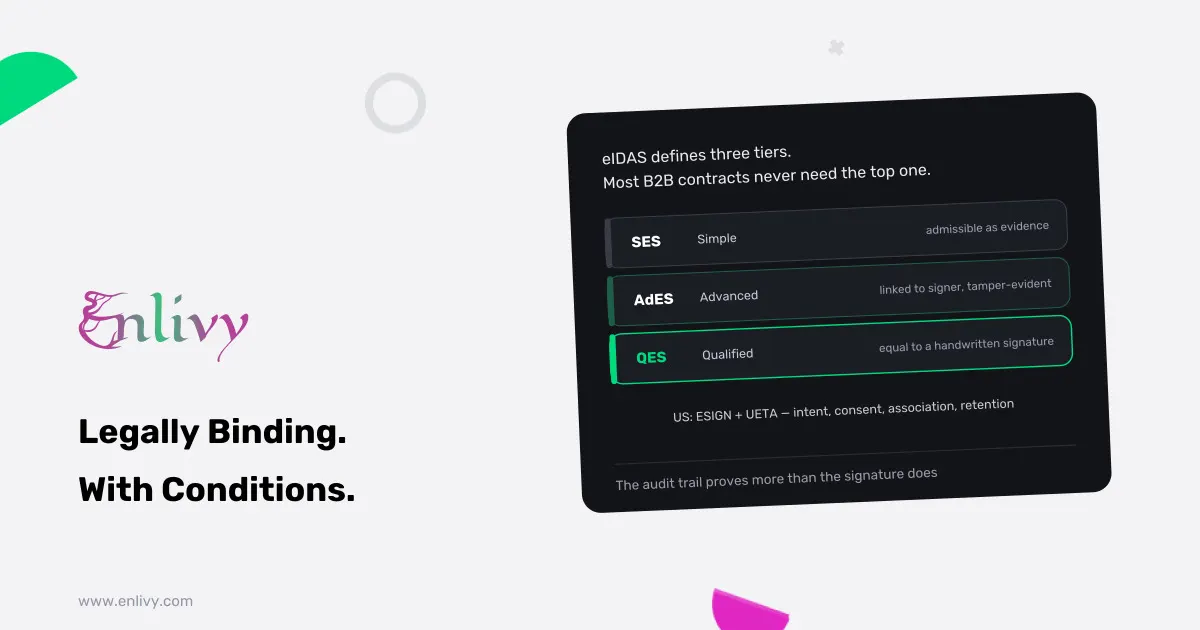
Storing the signed set together is what contracts against the client record is for, and where several people have to approve a change, sending it to each signer and tracking who has signed is what stops it stalling. If the client questions whether the amendment is enforceable because it was signed electronically, ESIGN and eIDAS answer that.
None of the above is legal advice. Amendments touching liability, IP assignment or regulated data are worth an hour of a lawyer’s time.
Where this sits in the wider chain
An amendment is a change to the agreement, but the reason it matters is downstream: it changes what you bill. That link, where signed terms become the arrangement that produces invoices, is the fourth handoff in the contract-to-cash workflow, and the one where revenue goes missing most quietly.
For recurring work the amendment usually adjusts a retainer agreement, and the change has to land in the billing schedule to be worth anything. Drafting the amendment from maintained, reusable clauses rather than from a copy of a copy also means it starts from your current standard terms, which is part of what contract management is for.
Enlivy links the contract, its amendments and the billing schedule, sold as separate packs. You can start free; billing schedules are a paid pack.
If you are comparing tools that handle this, the write-ups on PandaDoc, Dubsado and HoneyBook cover where each stops.