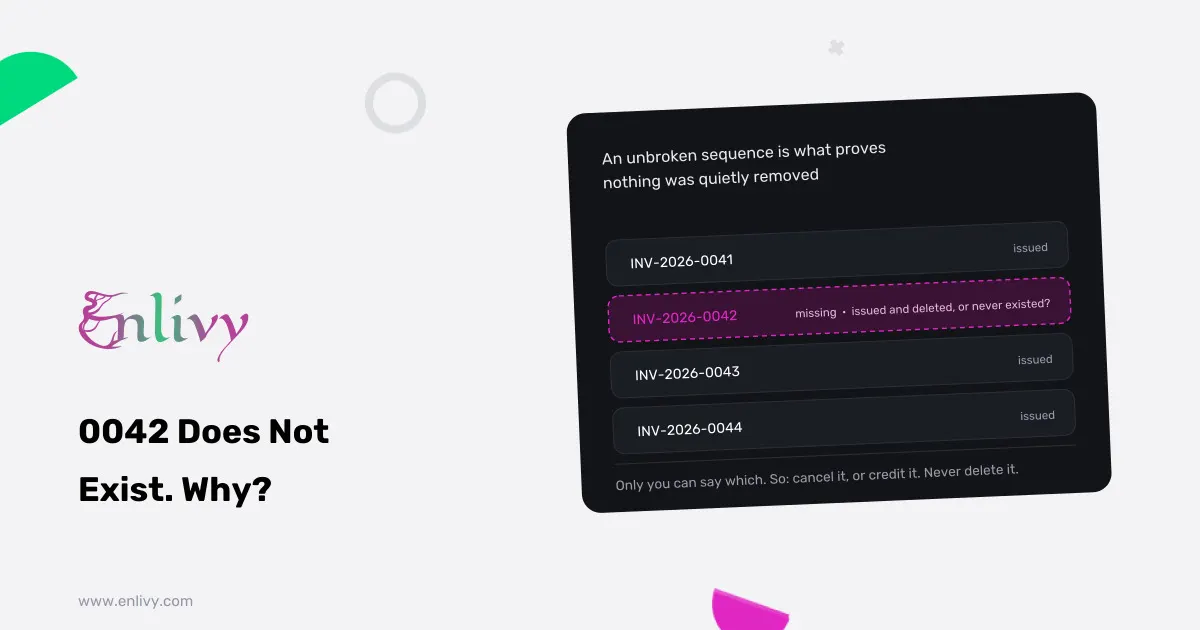
Invoice numbering looks like an administrative detail until an auditor asks why 0042 does not exist. Then it becomes the thing that decides whether your records are believed.
The requirement is short. Every invoice needs a unique identifier, and the identifiers need to form a sequence with no gaps. Everything else is preference.
Why the sequence matters
The point is not tidiness. An unbroken sequence is what makes it possible to prove that no invoice has been deleted.
If your numbers run 0041, 0043, 0044, one of two things happened. Either 0042 was issued and removed from the record, or it never existed. Only you can say which, and a document trail whose completeness depends on your word is not a document trail.
That is the entire reason the rule exists, and it explains several rules that otherwise seem arbitrary:
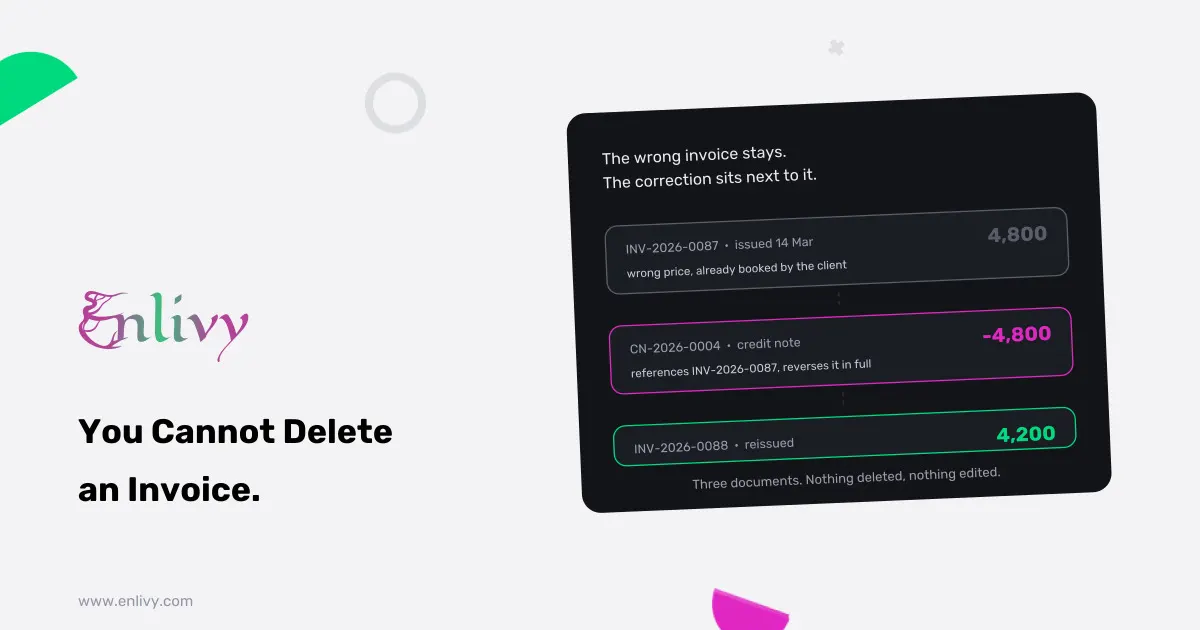
You cannot delete an issued invoice. You cancel it, or you correct it with a credit note, and the original stays in the sequence. A cancelled invoice with a zero total is fine. A missing number is not.
You cannot reuse a number. Two documents sharing an identifier makes both unreliable.
You cannot number after the fact. Sequence should follow issue order. Numbers assigned later, to match some other ordering, break the relationship between position and time.
What a good format contains
There is no single mandated format in most jurisdictions. These conventions survive contact with an audit and with your future self.
A prefix that identifies the series. INV-, or something meaningful when you run more than one. Prefixes are how you keep separate sequences separate without inventing a numbering scheme per document type.
The year. INV-2026-0001. Makes the document self-dating and makes the annual reset legible.
Zero padding. 0001 rather than 1. Sorts correctly everywhere, which matters more than it should.
No meaning encoded in the digits. Resist client codes or project references inside the number. The number’s job is identity. Everything else belongs in a field where it can be searched and changed.
Workable: INV-2026-0001, 2026-0001, INV-0001. Avoid anything where the sequential part is not obvious at a glance.
Restarting each year
Both approaches are defensible and the choice is yours, as long as it is consistent.
Continuous numbering never resets. Simplest possible audit story, and the number tells you nothing about when it was issued unless you include the year.
Annual reset returns to 0001 each January, with the year in the prefix carrying uniqueness. Common, readable, and the one most software assumes.
What you cannot do is switch mid-year without a clear break, or run both at once. If you change, change on 1 January and note why.
When separate series are right
One series is simplest. Several are justified when the documents genuinely differ:
By document type. Invoices, credit notes, receipts and proformas each want their own run. Mixing them makes each sequence unreadable, and a proforma consuming an invoice number is the single most common cause of an unexplained gap.
By legal entity. Separate companies keep separate books and therefore separate sequences. Not optional.
By country, where the rules differ. Some jurisdictions have specific requirements for domestic series. Worth checking rather than assuming.
Reasons that are not good enough: one series per client, per project, or per team member. Those are search filters, not identities, and each one multiplies the number of sequences somebody has to keep unbroken.
If the series exists mainly so that different kinds of work are billed differently, the thing to separate is usually the product catalog or the billing arrangement, not the numbering.
Fixing a gap you already have
Two situations, two different answers.
The invoice exists but is voided. Nothing to fix. Keep it in the sequence, marked cancelled, with a zero or reversed total. The number is accounted for, which is all the sequence asks.
The number was never used. Do not renumber later invoices to close the gap; that rewrites history and creates a much worse problem. Document what happened, in writing, at the time you notice. An explained gap is an administrative note. An unexplained one is a question you answer under pressure years later.
Either way, stop the cause. Nearly every gap traces back to a number being assigned at draft rather than at issue, so a draft that gets abandoned takes a number with it. Assigning at the moment of issue removes the whole class of problem.
Where numbering meets compliance
In much of the EU the invoice does not finish at your system. It has to be transmitted as structured data through a network, and the number travels with it as the document’s identity. Enlivy sends it to ANAF eFactura when a Romanian organization invoices a Romanian client, and exports a PEPPOL BIS 3.0 file or national e-invoice XML for you to submit everywhere else.
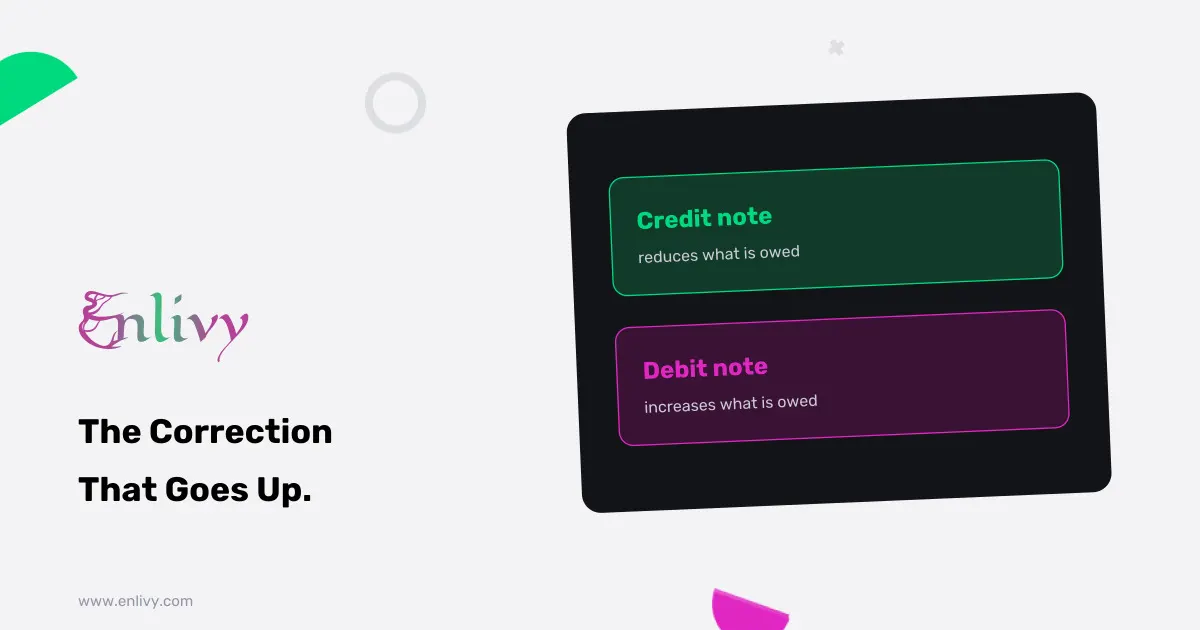
Two consequences follow. A number transmitted cannot quietly change afterwards, because the receiving system has already recorded it. And a correction has to reference the original number explicitly, which is what makes credit notes work as corrections rather than as new unrelated documents.
Where this sits in the wider chain
Numbering is a small rule at the centre of a longer path: an agreed price, a document that asks for it, a payment, and a reconciliation that proves it. The whole path, and where it leaks, is the contract-to-cash workflow.
It matters most where invoices are produced on a cadence rather than one at a time. A billing schedule issuing twelve invoices a year, or an invoice scheduled to issue itself, is exactly where hand-typed numbers drift. And knowing which numbers are settled depends on matching payments to invoices.
Enlivy runs the series, the documents and the money in one place, sold as separate packs. You can start free.
If you are comparing tools on this specifically, the write-ups on QuickBooks, Xero and Zoho Books cover how each handles sequences.