Key takeaways
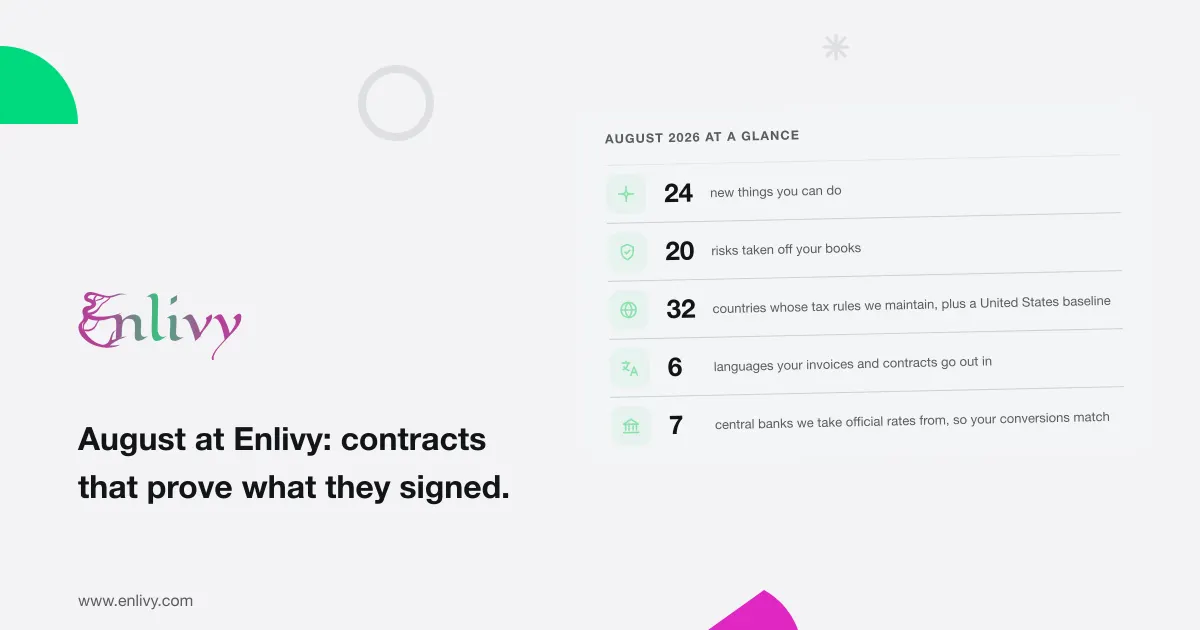
- A contract locks from the first signature, and each signature fingerprints the document that person actually saw
- You can close a deal that is not a sale. An NDA, a framework agreement, a grant, a share subscription: no invoice, no VAT, no billing schedule
- Your customer chooses the currency they pay in, sees what each one costs, and accepts at the rate you then bill at
- Your customer portal speaks their language and stays up through a release. Every organization has one again, which was not true for three months
- Twenty live risks are closed, from a signed contract that could still be edited to a dead exchange-rate feed nobody had noticed
- Two things need you: open a contract template and say who it binds, and take a sandbox copy before trying any of this on live data
The app you use every day got easier
Start with what you will notice the next time you open Enlivy.
The least glamorous work is here too. The app was generating none of the spacing rules two of its own component libraries asked for, which is why lists of cards sat flush against each other. Every page load fetched more than a megabyte that now ships inside the build. And the notice telling you a new version is ready was painting nothing at all, while every check reported success.
What August changed for you
The bigger changes, in order: proving what each party actually signed, closing a deal that is not a sale, a customer portal that finally works, and twenty live risks closed. The full list of all twenty-four is at the end.
Prove what each party actually signed
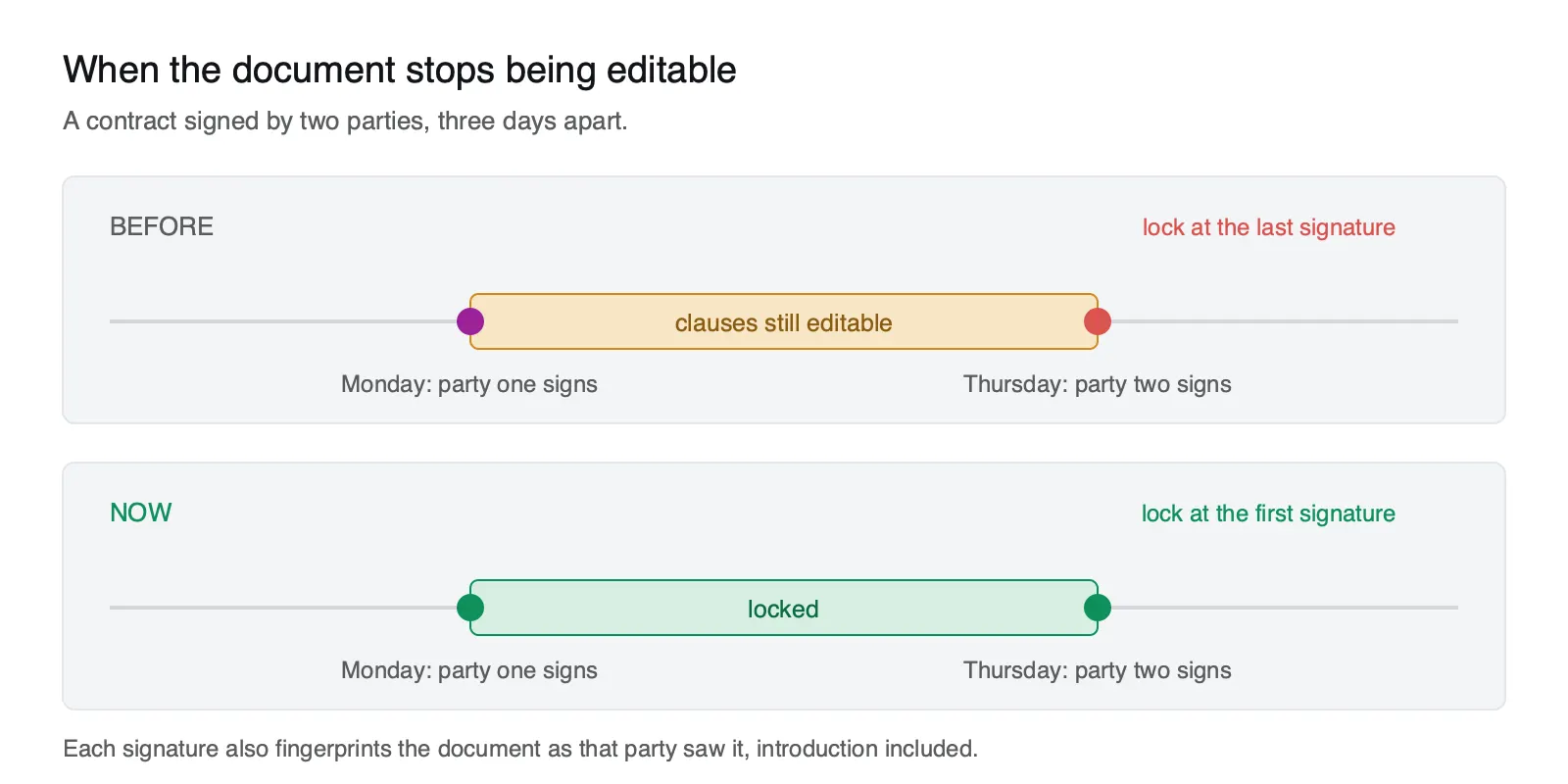
Contract generation only knew how to draw up a sale: you on one side, your customer on the other. Your company was always party one, even when it was not a party at all. So a contract between two other people could not be generated, and a third signatory had to be added by hand, after the introduction could no longer name them.
A template now says who it binds. For each party you pick where the details come from: your side, their side, a named contact, or nobody yet. A name and an email address are enough to be invited, verify and sign.
You also pick how much you need to know about them: contact details, an identity document, or full civil registry data. The portal asks for exactly that when they accept, the last moment they are in front of a form. One of our own loan templates asked for nothing, then waited forever on details nobody was going to request again.
Which leaves the harder question. We already sign electronically, so what was missing?
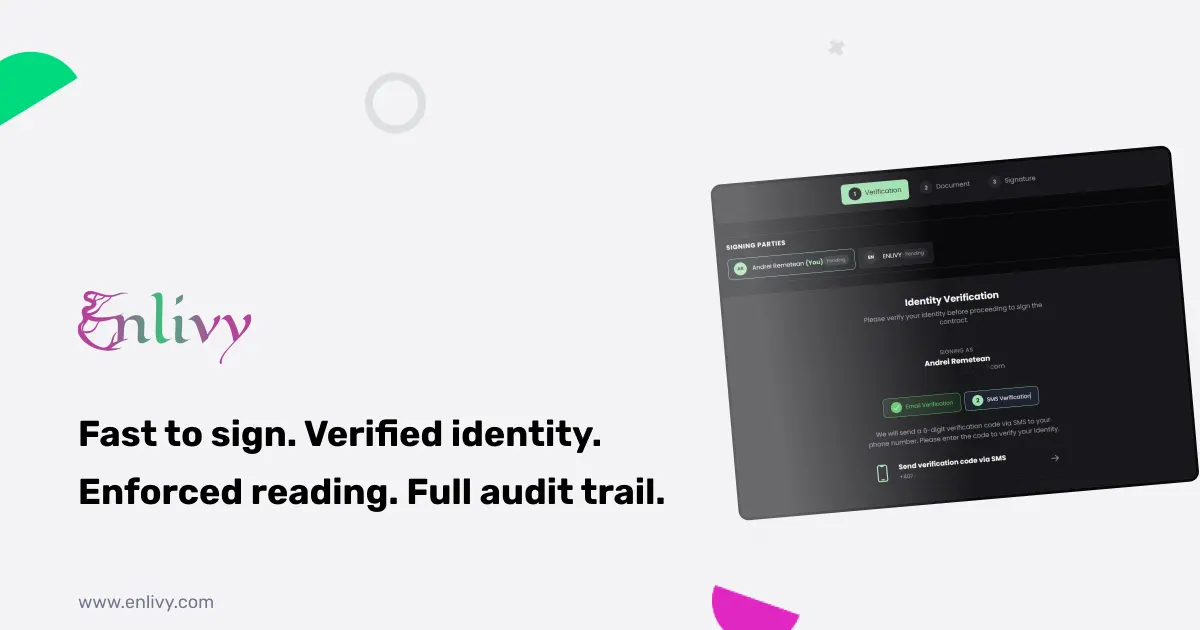
A signature proves who clicked. It does not prove what the page said when they clicked it. On a contract signed three days apart, that is the whole question.
Thirty-three signed contracts were sitting in that editable state when we found it. All thirty-three were ours. No customer contract was affected.
One honest limit. Under eIDAS, the European rules on electronic signatures, ours is a simple signature with good evidence behind it, not an advanced one. A code sent to a mailbox is not the same as sole control of a signing key, and the frozen document carries no third-party seal, so anyone checking it has to ask us. For most commercial contracts that is the right level. A deal that needs more needs a qualified provider.
Close a deal that is not a sale
Accepting a proposal always issued a proforma or an invoice. There was no way to say otherwise.
That is right for a sale and wrong for everything else. Shares, a convertible loan, a grant: that money is equity or a liability, never revenue, and VAT does not apply to it. Invoicing it gets your books and your VAT wrong at the same time.
A billing package now says how it settles, and that choice is fixed onto the proposal the moment it is created.
Neither non-sale option issues anything fiscal, opens a billing schedule, or takes a payment method. The deal settles once every contract it needs is signed. The contract says nothing about tax at all, because outside the scope of VAT is not the same as exempt. A zero, or an exemption reason, would each claim a treatment that does not apply.
You can also price a line by quantity, in bands. On a round selling shares at a price that steps with volume, every number used to be typed into the clause by hand, with nothing checking it.
Then there is what the deal is paid in. A proposal that left the currency open asked your customer to choose blind. The portal got a list of currency codes and no amounts, so the only figure on screen was the one you quoted.
Two limits. Enlivy is not your accountant and files nothing for you. It works out a figure, you declare the real one, and where the two disagree, yours wins.
And the rate we pin is the official one from the central bank you chose, not what your own bank gives you the day the money lands. Those two differ, and the difference is yours.
A customer portal that works, in their language
Your customer portal is the half of Enlivy your customers actually touch.
None of that was true a month ago. The worst of it is worth saying plainly.
The job that creates customer portals had failed on every run since 12 May. It wrote the failure to a log file and reported success, so nothing raised its hand for three months. No organization created in that window had a portal or an embed at all. Four were waiting by the time we found it, one of them our own test copy.
Nobody told those four at the time. Nothing had told us either, which is why the first fix was making that job report a failure instead of exiting quietly.
Language was the other half. All four flows shipped with no translations, so a Romanian buyer read an entire checkout in English while the rest of the app spoke Romanian, and a Romanian counterparty signing a Romanian deed read “Signed by” and “Signature type” in English. Forty-five of those phrases were written straight into the screens, so nobody could have translated them however hard they tried.
Twenty things that can no longer go wrong
Almost none of these were reported by a customer. They came out of asking questions nobody had asked before: which of our own events does nothing ever send, which rate feed has gone quiet, what happens if you walk the whole path a first-time buyer walks. That last one is how we found that 276 of our 300 portal contacts could not check out.
We fixed more than twenty things. These are the twenty that could have cost you money, a document, or access to your own account.
All twenty-four, in one list
Everything August added, including what the sections above did not stop on:
- Close a deal that is not a sale: funding, or an agreement with no money in it
- Price a line by quantity, in tiers, with the figures printed into the contract
- Let your customer choose the currency they settle in, seeing what each one costs
- Hold those figures while they decide, and re-quote on demand
- Lock the exchange rate at acceptance, and reuse it on every document after
- Name every party a contract binds, including a third one
- Say how completely each party must be identified
- Send a signing invitation with your own note, and see whether it went
- See which stage a proposal is at, and whose move it is
- Be told what happened to a proposal, with a log of every notice
- Reopen a proposal that was rejected or expired, contract included
- Attach and detach a proposal’s contracts from the proposal itself
- Drop a document on the dashboard and get back a filled form
- Record a supplier bill with its tax, its parties and its bank account filled in
- Pair a bank payment with the documents it settles
- Find a prospect’s duplicates, compare them side by side, and merge them
- Export everything you hold about one person
- Edit many records at once, with a before-and-after preview
- Empty your own trash, and get the storage back
- Put a deadline on a public file link
- Keep your own blocklist of addresses, domains and phone numbers
- Take a sandbox copy of your organization, and carry records into it
- Give someone a Salesperson role, with permission per prospect status
- Require your own privacy policy on an embed on your site, and watch the funnel it runs
A contract is a promise about what was agreed. A signature is a claim about when.
If those two ever disagree you find out at the worst possible moment, usually from somebody else. Most of August went into making sure they cannot, and into the deals that never fitted a sales system in the first place: the ones where nothing is being sold at all.
If you take one action after reading this, open one contract template and say who it binds. Five minutes, and it decides what every deal drawn from it can prove later. New to Enlivy? Start free.