


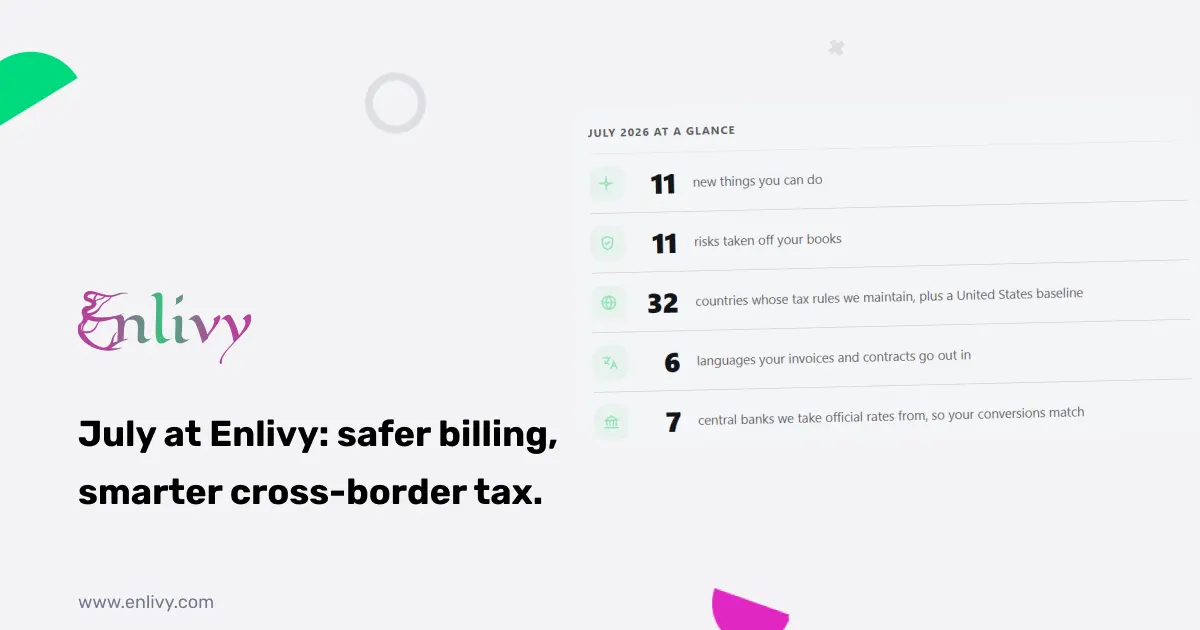
If you sell to a customer in another country, the tax on that invoice is not the tax you normally charge.
Getting it wrong is not a rounding error.
July was about that problem. Not the tax field on an invoice, but the machine underneath it: what you are registered for, which rate applies to which customer, and what you owe and when.
This is the first of a monthly update, and the shape will not change.
Key takeaways
- Cross-border tax is worked out for you in 32 countries, from what you are registered for and who you are selling to, rather than from a single “VAT exempt” tickbox
- A refund is one action on a paid invoice. The money, the credit note and the receipt all move together, and they match
- Eleven live defects are closed, including a cancelled contract that could still be signed, and a customer who could not finish signing
- Your billing can run inside your own site, in wording you write
- Two things need you: declare your registrations, and say whether Enlivy tracks your filing calendar or your accountant keeps doing it
What July changed for you
The eleven, in full:
- Refund an invoice, in full or by line
- See the payment reminders queued on an invoice before they send
- Start a billing schedule straight from a package, instead of rebuilding it by hand
- Put Enlivy’s billing screens inside your own site
- Write your own customer-facing wording, per language
- Import your products and customers from a spreadsheet
- Declare what you are registered for, and track what you owe against it
- Ask whether tax applies to a sale, and get the reason, not just a number
- Preview an e-invoice before it goes to the tax authority
- See everything a contract is holding up: invoices, schedules, receipts
- Narrow an app’s access after you have granted it
Cross-border sales without guessing the tax
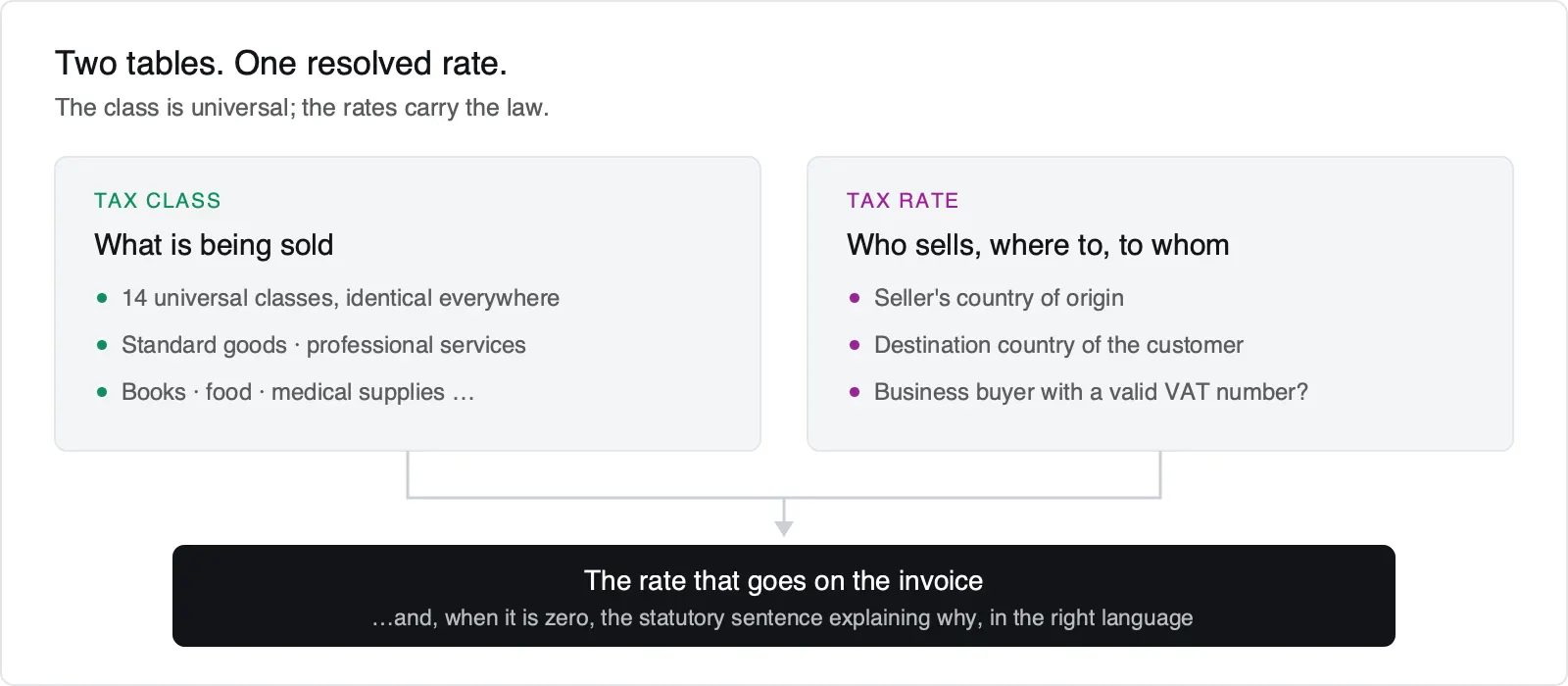
A Romanian company invoicing a German business does not charge Romanian VAT.
It charges nothing, and prints a specific legal sentence saying why, because the buyer accounts for the tax at their end. That is the reverse charge.
Get it wrong and you have issued an incorrect fiscal document, and you usually find out months later from somebody else.
Enlivy now works this out for you across 32 countries: the 27 EU member states, Iceland, Norway and Liechtenstein, the United Kingdom and Switzerland. We maintain those rules, cross-check them every morning against the European Commission’s own tax database, and version them so history stays intact, which is why the invoice you issued last year is still correct under last year’s law.
Three things changed underneath that:
- You declare your own standing. What you are registered for, where, from when, and under which scheme: the small-business exemption, cash accounting, and the One Stop Shop schemes for selling to consumers across the EU. It used to be a single “VAT exempt” tickbox.
- Filing is now your choice. Holding a registration used to conscript you into a calendar of statutory deadlines. It generated fifty filing periods for our own company against an empty ledger, forty-four already past due. Charging tax and filing returns are different jobs. You now opt in, and “my accountant files elsewhere” is an answer the system accepts.
- Your conversions match the tax office’s. Most jurisdictions name which central bank’s rate is authoritative. Enlivy takes official rates from seven of them and uses the statutory one for anything fiscal. Money already charged keeps its rate permanently.
You may be thinking: my accountant already handles this.
They handle the filing. They are not there when you issue the invoice, and that is where the rate is decided.
Every taxable sale now lands in a subledger: a running journal kept separately from your invoices. That is what lets Enlivy tell you what you owe, warn you when you are approaching a registration threshold in a country you are not registered in, and hand your accountant sales and purchase journals. Romanian accounting software reads them directly today.
Before any of it went live we put the design through five separate adversarial reviews, one per jurisdiction, each read against the actual statutes rather than our own summary of them. All five said the foundation was right. All five also came back with things we cannot express yet, and we wrote that list down instead of only the verdict. Germany, France and the UK do not have their own filing calendars in Enlivy for exactly that reason.
Two limits, stated plainly:
- Enlivy is not your accountant and does not file for you. It computes a figure, you declare the real one, and where the two disagree yours wins.
- The United States is a baseline only, because US sales tax is decided state by state.
Refund an invoice without calling your accountant
Until July you could take money in, but not send it back. Refunding a customer meant three separate jobs:
- Move the money in your payment provider
- Ask your accountant for a credit note to match it
- Check that the two agreed
It is now one action on any paid invoice, in the actions menu on the invoice itself. Refund the whole thing, or pick the lines and quantities to send back.
That last one matters more than it sounds. If the original invoice was missing a company number, the reversal is missing it too, wrong in exactly the same way. That is the only way the two documents reconcile.
Eleven things that can no longer go wrong
The first one is worth a sentence more, because signing was not where it stopped: completing that signature could also start the billing sitting behind the contract.
There was also a speed problem worth naming. If you invoice in more than one currency, your dashboards had degraded to twelve seconds. Our own multi-currency work caused it: every converted figure was searching four years of exchange-rate history to find one rate. They now answer in well under a second.
Nothing on this list is a setting you have to find. These are fixes, not features, and where the filing-deadline bug had already written rows wrong, those were recomputed in place rather than left for you to notice.
The app you use every day got easier
The back office got a visual refresh: a new palette, and panels that sit in clear layers instead of running together.
The parts you touch most got attention too:
- Pickers show what you are picking. Banks appear as logo cards rather than a list of names, and language choices as flags.
- Your business profile tells you what is missing. A customer record with no legal structure, or missing a required identifier for its country, now says so on the card instead of failing later.
- The notification timeline reads in English, not in system slugs. New notification types now name themselves without waiting for a release.
- Bank-transfer instructions name the billed currency when it differs from the one you were quoted.
Plus tooltips that stay on screen, money columns that wrap instead of overflowing, and readable tables in rich text.
Enlivy, inside your own site
If you already have a website, a checkout, or an app your customers use, your billing no longer has to live somewhere else. Five surfaces mount from one script tag, each sealed so your styles and ours cannot collide:
- Their billing details: legal structure, tax identifiers, address
- Their saved cards, to add, remove, or set a default
- A card picker, for your own checkout
- Their subscriptions, with pause, resume and cancel
- A package to buy, which needs no login at all
The signed-in ones report back when a customer saves something, so your checkout can carry on.
Your customer portal also picked up wording you control. The tax explainer, the estimate note and the messages a prospect sees can all be written by you, in each language.
And getting your business in got easier. Products and customers now import from a spreadsheet, with the columns matched up for you and large files picking up where they left off. It is under Products, then Imports, and the same under Users. Moving your data in is usually the hardest part of changing software, and the reason most people never do.
What’s next
You should never have to think about any of this.
You will not open Enlivy in August wondering which central bank valued a tax figure, or whether a credit note used the original invoice’s company number or today’s.
That is the point.
If you take one action after reading this, make it the registrations screen. Ten minutes, and everything above depends on it. New to Enlivy? Start free, then open it.
We will do this again at the start of September.